

In Japan, the character 死 (shi, meaning “death”) is so avoided that the country’s official family registry actually rejects birth names containing it, and even the sound “shi” gets sidestepped whenever possible. That’s why true Japanese girl names that mean death barely exist in real life.
Instead, Japanese naming culture works around the edges, using kanji for shadow, spirit, the underworld, grief, and darkness to hint at mortality without naming it outright. This creates a rich, poetic space between real tradition and pure imagination.
This article collects 125+ Japanese girl names that mean death, spanning genuine Japanese vocabulary, mythology, folklore, and invented names built for fiction, each explained with accurate meanings, origins, and pronunciation.
Did You Know?
The koseki (Japan’s official family registry) actually rejects birth names containing certain inauspicious kanji, which is one reason a name like Kanshi (sorrowful death) will never show up on a real Japanese birth certificate, only in fiction.
The taboo runs so deep that even the sound “shi” is avoided where possible, since it’s a homophone for 死 (death), the same superstition behind hospitals skipping room and floor number four. It’s a rare case where a culture’s naming customs and its number superstitions come from the exact same syllable.
Quick Checklist Before Choosing a Japanese Girl Name That Means Death
Before picking one of these names, check a few simple things:
- Confirm the kanji meaning, not just the sound (many “death” names shift meaning with different kanji)
- Ask a native speaker or trusted source if it’s real or fictional
- Check how the name feels in daily life, not just in a story
- Think about pronunciation for non-Japanese speakers
- Decide if it’s for a baby, a character, or creative writing, since the rules differ
Dark & Mysterious Japanese Girl Names
Yoru (夜)
- Meaning: Night
- Origin: Japanese
- Root: 夜 (yoru), the standard kanji/word for “night”
- Pronunciation: YOH-roo
- Gender: Girl
- A name built directly from the word for night itself, Yoru carries a quiet, enveloping darkness rather than anything sinister. It’s rare as a standalone given name in Japan, more often appearing as part of longer names, so using it alone feels deliberate and atmospheric.
Rei (怜/零)
- Meaning: Cold, clever, or “zero/spirit” depending on kanji
- Origin: Japanese
- Root: Multiple kanji readings — 怜 (clever/cool-headed), 零 (zero), or 霊 (spirit) when written differently
- Pronunciation: RAY
- Gender: Girl (also used as unisex)
- Rei is genuinely popular in Japan, but its meaning shifts entirely depending on which kanji parents choose — which is what gives it a mysterious edge here. When written with 霊, it brushes against “spirit” or “soul,” giving an otherwise common name a ghostly undertone.
Ai (哀)
- Meaning: Sorrow, grief
- Origin: Japanese
- Root: 哀 (ai), distinct from the far more common 愛 (ai, meaning “love”)
- Pronunciation: EYE
- Gender: Girl
- This is a striking case of homophones pulling in opposite directions — the beloved name Ai almost always uses the “love” kanji, but written with 哀 it becomes “sorrow” instead. Parents rarely choose this darker version intentionally, which makes it feel like a hidden, secondary meaning lurking beneath a familiar sound.
Kage (影)
- Meaning: Shadow
- Origin: Japanese
- Root: 影 (kage), meaning shadow or silhouette
- Pronunciation: KAH-geh
- Gender: Unisex
- Kage isn’t really used as a standalone given name in Japan — it’s more common as a surname element or in fiction (ninja and shadow-clan tropes especially) — so treat it as a stylized, fantasy-leaning choice. It has a cool, understated menace to it, evoking something that follows just behind you without ever stepping into the light.
Karasu (烏)
- Meaning: Crow
- Origin: Japanese
- Root: 烏 (karasu), the word for crow or raven
- Pronunciation: kah-RAH-soo
- Gender: Girl
- Crows hold a complicated place in Japanese culture — they’re associated with Yatagarasu, the three-legged sacred crow that guided the first emperor, but also with omens and death in folklore. As a name it’s unconventional and bold, more likely to show up in fiction than a birth registry.
Tsukiyo (月夜)
- Meaning: Moonlit night
- Origin: Japanese
- Root: 月 (tsuki, moon) + 夜 (yo, night)
- Pronunciation: tsoo-KEE-yoh
- Gender: Girl
- Tsukiyo has actually seen real use as a Japanese given name, and it manages to feel eerie and beautiful at once — a night lit only by moonlight rather than plunged into total darkness. It reads as poetic instead of ominous, which is part of its appeal.
Yamiko (闇子)
- Meaning: Child of darkness
- Origin: Invented/modern
- Root: 闇 (yami, darkness) + 子 (ko, child), a suffix common in older-generation Japanese names
- Pronunciation: yah-MEE-koh
- Gender: Girl
- This is not a traditional Japanese name — it’s a modern, invented combination built to sound authentic using the classic “-ko” ending. It’s popular in fantasy naming circles precisely because it reads as plausible while wearing its dark meaning openly.
Yozora (夜空)
- Meaning: Night sky
- Origin: Japanese
- Root: 夜 (yo, night) + 空 (sora, sky)
- Pronunciation: yoh-ZOH-rah
- Gender: Girl
- Yozora leans more romantic than frightening, conjuring a sky full of stars rather than an empty void, though the “night” root keeps it firmly in dark-and-mysterious territory. It occasionally appears in anime and literature as a character name for exactly this reason.
Kuroyuri (黒百合)
- Meaning: Black lily
- Origin: Japanese
- Root: 黒 (kuro, black) + 百合 (yuri, lily)
- Pronunciation: koo-roh-YOO-ree
- Gender: Girl
- The black lily is a real flower native to Japan’s alpine regions, long associated in Ainu and northern Japanese folklore with curses and doomed love — there’s a well-known legend that giving someone a black lily binds their fate to yours. It’s a genuinely evocative name for anyone drawn to flower names with a shadow side.
Ankoku (暗黒)
- Meaning: Deep darkness, pitch black
- Origin: Japanese (archaic/literary)
- Root: 暗 (an, dark) + 黒 (koku, black)
- Pronunciation: ahn-KOH-koo
- Gender: Girl
- Ankoku is essentially never used as a personal name — it belongs to literary and dramatic vocabulary, often describing a metaphorical “dark age” or abyss. Including it here is a stylistic choice for people who want something that sounds unmistakably ominous rather than a name you’d expect to meet in real life.
Beautiful Japanese Girl Names with Dark Meanings
Shinju (心中/真珠)
- Meaning: Pearl, or “double suicide” depending on kanji
- Origin: Japanese
- Root: 真珠 (shinju, pearl) versus 心中 (shinjū, a term historically used for lovers’ joint suicide)
- Pronunciation: SHEEN-joo
- Gender: Girl
- This is one of the more genuinely startling homophones in Japanese — the elegant, widely-used name Shinju means pearl, but the identically-pronounced 心中 carries centuries of weight from Edo-period literature and kabuki, where double-suicide pacts between doomed lovers were a recurring tragic theme. In practice everyone uses the pearl kanji, but the shadow meaning is well known to Japanese speakers.
Namida (涙)
- Meaning: Tears
- Origin: Japanese
- Root: 涙 (namida), the standard word for tears
- Pronunciation: nah-mee-DAH
- Gender: Girl
- Namida is soft and melancholy rather than frightening, and while it’s not a common given name in Japan, it shows up in songs, poetry, and character names for its raw emotional pull. It suits a name list about beauty tangled with sadness better than almost anything else on this page.
Kuroe (黒恵)
- Meaning: Black blessing
- Origin: Invented/modern
- Root: 黒 (kuro, black) + 恵 (e, blessing or grace)
- Pronunciation: koo-ROH-eh
- Gender: Girl
- Kuroe pairs a real, common kanji for grace or blessing (恵, as in Megumi) with the darker “black,” making it a modern invented name rather than something you’d find in Japanese birth records. It’s the kind of contradiction — beauty and darkness fused in one syllable pair — that makes invented names appealing for fiction.
Higan (彼岸)
- Meaning: The far shore; a Buddhist term for the realm beyond death
- Origin: Japanese, Buddhist terminology
- Root: 彼岸 (higan), literally “the other shore,” referring to enlightenment or the world of the dead in Buddhist cosmology
- Pronunciation: hee-GAHN
- Gender: Girl
- Higan is best known in everyday Japanese as the name of a Buddhist observance week honoring ancestors, held during the equinoxes — it’s also when higanbana, the red spider lily, blooms, a flower itself tied to graveyards and farewells. Used as a given name it’s unusual and quietly poetic rather than common.
Rinne (輪廻)
- Meaning: Reincarnation, the cycle of death and rebirth
- Origin: Japanese, Buddhist terminology
- Root: 輪廻 (rinne), a Buddhist concept borrowed from Sanskrit “samsara”
- Pronunciation: REEN-neh
- Gender: Girl
- Rinne has genuinely been used as a real Japanese given name, often written with softer kanji that don’t spell out the full Buddhist term, so the name itself sounds light and musical even though its root concept is about the endless wheel of death and rebirth. It’s become fairly recognizable internationally through anime characters carrying the name.
Meifu (冥府)
- Meaning: The underworld, land of the dead
- Origin: Japanese, from Chinese-derived vocabulary
- Root: 冥 (mei, dark/hidden, associated with the afterlife) + 府 (fu, administrative realm)
- Pronunciation: MAY-foo
- Gender: Girl
- Meifu isn’t a real given name in Japan — it’s formal vocabulary describing the land of the dead in Buddhist and Taoist-influenced cosmology, closer to “Hades” than to any human name. It’s included here as an evocative, invented-use option for anyone wanting something that sounds hauntingly formal.
Yamiyo (闇夜)
- Meaning: Pitch-dark night
- Origin: Invented compound, built from standard Japanese words
- Root: 闇 (yami, darkness) + 夜 (yo, night)
- Pronunciation: yah-MEE-yoh
- Gender: Girl
- Unlike Tsukiyo’s moonlit night, Yamiyo describes a night with no moon at all — total darkness. It’s not a documented traditional name but reads naturally in Japanese, making it a plausible modern coinage for someone who wants the “night” theme pushed further into shadow.
Nokoribi (残り火)
- Meaning: Embers, the last remnants of a dying fire
- Origin: Invented, from a real Japanese word
- Root: 残り (nokori, remainder) + 火 (bi, fire)
- Pronunciation: noh-koh-REE-bee
- Gender: Girl
- Nokoribi is a genuine word in Japanese poetry describing the glow left after a fire has mostly burned out — beautiful, warm, and tinged with the sense of something ending. As a given name it would be unusual and invented, but it carries real linguistic roots rather than being built from scratch.
Tsuya (通夜/艶)
- Meaning: Wake or vigil for the dead, or alternately “glossy/charming”
- Origin: Japanese
- Root: 通夜 (tsuya, funeral wake) versus 艶 (tsuya, glossiness, allure)
- Pronunciation: TSOO-yah
- Gender: Girl
- Tsuya is a real Japanese given name, almost always using the “charm/glossiness” kanji 艶, which gives it a genuinely lovely, elegant meaning about lustrous beauty. Its darker homophone, however, refers specifically to the overnight wake held before a Japanese funeral — a striking coincidence for anyone drawn to double meanings.
Meido (冥土)
- Meaning: The land of the dead
- Origin: Japanese, Buddhist-derived vocabulary
- Root: 冥 (mei, dark/hidden realm of the afterlife) + 土 (do, land)
- Pronunciation: MAY-doh
- Gender: Girl
- Meido is standard vocabulary in Japanese Buddhism for the afterlife journey, not a personal name, so its inclusion here is meant for fictional or stylistic use only. It sounds soft and almost delicate when spoken, which is exactly the tension that makes “beautiful sound, dark meaning” names compelling.
Rare Japanese Girl Names That Mean Death
Shide (死出)
- Meaning: Setting out toward death
- Origin: Japanese, Buddhist/literary
- Root: 死 (shi, death) + 出 (de, to depart)
- Pronunciation: SHEE-deh
- Gender: Girl
- Shide refers to the mountain path the dead are believed to cross in the afterlife according to Japanese Buddhist tradition, comparable to crossing the River Styx. It is essentially never used as an actual given name because of its heavy, literal association with dying, so treat this strictly as a rare, symbolic option for creative naming.
Meikai (冥界)
- Meaning: The realm of the dead
- Origin: Japanese, from Chinese-derived vocabulary
- Root: 冥 (mei, hidden/dark afterlife) + 界 (kai, realm)
- Pronunciation: MAY-kai
- Gender: Girl
- Meikai shows up constantly in manga, anime, and fantasy fiction as a term for the underworld, but it has no history as a real personal name in Japan. Its appeal here is purely aesthetic and symbolic rather than something rooted in actual naming practice.
Reikon (霊魂)
- Meaning: Soul, spirit of the dead
- Origin: Japanese
- Root: 霊 (rei, spirit) + 魂 (kon, soul)
- Pronunciation: RAY-kohn
- Gender: Girl
- Reikon is the formal Japanese word encompassing both body-soul and spirit-of-the-dead concepts in folk religion, closely tied to ancestor worship. It reads more like a philosophical term than a name, but its two syllables pair well and it’s occasionally adapted by writers looking for something spirit-adjacent.
Jashin (邪神)-adjacent: Yomi (黄泉)
- Meaning: The underworld in Shinto mythology
- Origin: Japanese, Shinto
- Root: 黄泉 (Yomi), literally “yellow springs,” the land of the dead in the Kojiki creation myths
- Pronunciation: YOH-mee
- Gender: Girl
- Yomi is the actual land of the dead described in Japan’s oldest chronicles, the place Izanami retreated to after dying and where Izanagi famously tried to bring her back. As a name it’s rare and dramatic — more a mythological place name repurposed than a traditional personal name — but it carries genuine, deep-rooted Shinto significance.
Somei (葬)** — replaced below for accuracy
Sougi (葬儀)
- Meaning: Funeral rite
- Origin: Japanese
- Root: 葬 (sou, burial/funeral) + 儀 (gi, ceremony)
- Pronunciation: SOH-gee
- Gender: Girl
- Sougi is purely functional vocabulary for a funeral ceremony and has no history as a given name — it’s here as a linguistic curiosity for those building fictional or atmospheric names rather than a real-world option. Its blunt, ceremonial meaning makes it one of the more literal “death” entries on this list.
Meifu-hime (invented, from 冥府)
- Meaning: Princess of the underworld
- Origin: Invented/modern compound
- Root: 冥府 (meifu, underworld) + 姫 (hime, princess)
- Pronunciation: may-foo-HEE-meh
- Gender: Girl
- This is a constructed, fictional-style name combining the underworld term with the classic “-hime” princess suffix seen in mythological figures like Konohanasakuya-hime. It’s not a real Japanese name but fits naturally alongside historical naming patterns, which is why it circulates in fantasy and game character naming.
Kanshi (哀死)
- Meaning: Sorrowful death
- Origin: Invented compound
- Root: 哀 (kan/ai, sorrow) + 死 (shi, death)
- Pronunciation: KAHN-shee
- Gender: Girl
- Kanshi as constructed here isn’t a documented Japanese word or name — it’s a plausible-sounding invented compound built from two real kanji. It’s worth noting that shi (死) itself is almost never used in real Japanese names because it’s considered deeply inauspicious, one reason genuinely “death-named” people essentially don’t exist in Japan.
Higanbana (彼岸花)
- Meaning: Red spider lily, literally “flower of the other shore”
- Origin: Japanese
- Root: 彼岸 (higan, the far shore/afterlife) + 花 (hana, flower)
- Pronunciation: hee-gahn-BAH-nah
- Gender: Girl
- This flower blooms around graveyards and Buddhist equinox observances in Japan and is steeped in death symbolism — folklore warns that picking one brings misfortune, and it’s traditionally planted near graves to ward off pests from disturbing the dead. As a name it’s unconventional but botanically real and rich with meaning for anyone wanting something rare and specific.
Kuroshi (invented, 黒死)
- Meaning: Black death
- Origin: Invented compound
- Root: 黒 (kuro, black) + 死 (shi, death)
- Pronunciation: koo-ROH-shee
- Gender: Girl
- Kuroshi is a modern, invented pairing rather than an attested Japanese name, echoing the same construction used for “Black Death” in English. Like Kanshi, it uses the taboo character 死 directly, which is precisely why real Japanese parents would avoid it — its rarity here comes from cultural avoidance rather than obscurity.
Meikyo (冥境)
- Meaning: Border of the underworld
- Origin: Invented compound
- Root: 冥 (mei, dark afterlife realm) + 境 (kyo, border/boundary)
- Pronunciation: MAY-kyoh
- Gender: Girl
- Meikyo is constructed from real, meaningful kanji but doesn’t exist as an established word or name in Japanese — it describes a liminal threshold between the living world and the afterlife. It works well as a mysterious, invented option for fiction that wants the sound of authenticity without literal, documented use.
Gothic & Haunting Names
Yūrei (幽霊)
- Meaning: Ghost
- Origin: Japanese
- Root: 幽 (yū, faint/dim) + 霊 (rei, spirit)
- Pronunciation: YOO-ray
- Gender: Girl
- Yūrei is the standard Japanese word for ghost, specifically the kind bound to the earthly world by strong emotion — grief, vengeance, or unfinished business — rather than resting peacefully. It isn’t used as a real personal name in Japan, but it’s instantly recognizable and dramatic if you want something that names the concept of haunting directly.
Ubume (産女)
- Meaning: A yokai spirit of a woman who died in childbirth
- Origin: Japanese folklore
- Root: 産 (ubu, birth) + 女 (me, woman)
- Pronunciation: oo-BOO-meh
- Gender: Girl
- Ubume comes from a specific and genuinely sorrowful strand of Japanese folklore — spirits said to appear cradling infants, seeking help for the child they couldn’t raise in life. It’s a mythological figure name rather than a real given name, carrying real emotional weight if you know the story behind it.
Onibi (鬼火)
- Meaning: Demon fire, will-o’-the-wisp
- Origin: Japanese folklore
- Root: 鬼 (oni, demon/ogre) + 火 (bi, fire)
- Pronunciation: oh-NEE-bee
- Gender: Girl
- Onibi describes the eerie floating flames said to appear over graveyards and marshes in Japanese folklore, often believed to be the souls of the restless dead. It has a crackling, atmospheric sound that suits its imagery well, though it’s used as a folkloric term rather than an actual personal name.
Nue (鵺)
- Meaning: A chimeric yokai with a monkey’s face, tanuki’s body, tiger’s limbs, and snake’s tail
- Origin: Japanese mythology
- Root: 鵺, a name specific to this legendary creature, first recorded in the Heike Monogatari
- Pronunciation: NOO-eh
- Gender: Unisex
- The Nue is one of the most distinctive monsters in Japanese legend, said to cry like a thrush and bring misfortune wherever it appeared, famously shot down by the warrior Minamoto no Yorimasa. As a name it’s bold and unconventional, borrowed wholesale from myth rather than any tradition of human naming.
Yukionna (雪女)
- Meaning: Snow woman
- Origin: Japanese folklore
- Root: 雪 (yuki, snow) + 女 (onna, woman)
- Pronunciation: yoo-kee-OHN-nah
- Gender: Girl
- Yukionna is a well-known yokai said to appear during snowstorms, luring travelers to their deaths with her cold, otherworldly beauty — Lafcadio Hearn’s retelling made her famous outside Japan too. Using the full name as a given name would be unusual, but it’s instantly evocative for anyone building a gothic, winter-haunted character.
Kitsune (狐)
- Meaning: Fox
- Origin: Japanese
- Root: 狐 (kitsune), the word for fox, deeply tied to Shinto mythology and the messenger god Inari
- Pronunciation: kee-tsoo-neh
- Gender: Girl
- Kitsune spirits in Japanese folklore are shapeshifters known for cunning, magic, and sometimes taking human form to deceive or seduce — they’re neither wholly good nor evil, which gives the name real narrative texture. It isn’t used as an actual human name in Japan, functioning more like naming a child “Fox Spirit” would in English.
Tamamo (invented, from Tamamo-no-Mae)
- Meaning: Shortened form referencing a legendary nine-tailed fox spirit
- Origin: Japanese mythology
- Root: From 玉藻の前 (Tamamo-no-Mae), a legendary courtesan revealed to be a malevolent nine-tailed fox
- Pronunciation: tah-MAH-moh
- Gender: Girl
- Tamamo-no-Mae is one of Japan’s great mythological villainesses, a fox spirit whose true form was uncovered after she bewitched an emperor, and whose death is said to have created a stone that poisons anyone who touches it. Shortening the full name to “Tamamo” for use as a given name is a modern, informal adaptation rather than historical practice.
Rokuro (invented, from Rokurokubi)
- Meaning: Shortened reference to a yokai whose neck stretches unnaturally at night
- Origin: Japanese folklore
- Root: From 轆轤首 (rokurokubi), a species of yokai
- Pronunciation: roh-koo-roh
- Gender: Unisex
- Rokurokubi appear human by day but are said to stretch their necks to impossible lengths after dark, often to spy or frighten. Note that “Rokuro” alone is actually a legitimate standalone Japanese given name in its own right (meaning “sixth son” in some traditional uses), so the yokai association here is a stylistic reinterpretation rather than the word’s original meaning.
Hone (骨)
- Meaning: Bone
- Origin: Japanese
- Root: 骨 (hone), the standard word for bone
- Pronunciation: HOH-neh
- Gender: Girl
- Hone is not used as a personal name in Japan — it’s a plain anatomical word — but its stark, single-syllable bluntness gives it real gothic punch for invented or fictional use. It’s the kind of name that trades subtlety for directness, evoking something skeletal and bare.
Kurotsuki (invented, 黒月)
- Meaning: Black moon
- Origin: Invented compound
- Root: 黒 (kuro, black) + 月 (tsuki, moon)
- Pronunciation: koo-roh-TSOO-kee
- Gender: Girl
- Kurotsuki isn’t a documented Japanese name, but it follows a completely natural compound pattern (similar to real names like Mizuki, “beautiful moon”), which is why it reads as plausible. It evokes a moon in eclipse or shadow — visually striking, and popular in fan-created or original fantasy naming.
Mythological & Spirit-Inspired Names
Izanami (伊邪那美)
- Meaning: “She who invites”
- Origin: Japanese, Shinto mythology
- Root: From the Kojiki and Nihon Shoki creation myths
- Pronunciation: ee-zah-NAH-mee
- Gender: Girl
- Izanami is one of the primal creator deities in Shinto mythology, who died giving birth to the fire god and became ruler of Yomi, the underworld — her later, horrifying confrontation with her husband Izanagi is one of Japan’s most famous myths. It’s a genuinely powerful mythological name, though it’s rarely if ever used for real children given its heavy divine associations.
Amaterasu (天照)
- Meaning: “Shining in heaven”
- Origin: Japanese, Shinto mythology
- Root: 天 (ama, heaven) + 照 (terasu, to shine)
- Pronunciation: ah-mah-teh-RAH-soo
- Gender: Girl
- Amaterasu is the sun goddess and the most important deity in the Shinto pantheon, considered the mythical ancestor of the Japanese imperial line. Using it as a personal name would be highly unusual in Japan given its sacred status, but internationally it’s become a recognizable choice for people drawn to sun and light mythology.
Konohana (木花)
- Meaning: Tree blossom, shortened from Konohanasakuya-hime
- Origin: Japanese, Shinto mythology
- Root: 木 (ko, tree) + 花 (hana, blossom)
- Pronunciation: koh-noh-HAH-nah
- Gender: Girl
- Konohanasakuya-hime is the goddess associated with Mount Fuji and cherry blossoms, symbolizing delicate, fleeting earthly life in contrast to her sister who represents eternal rock-like permanence. The shortened form “Konohana” makes a lovely, softer entry point into her story for modern naming use.
Benten (弁天)
- Meaning: Goddess of music, eloquence, and water
- Origin: Japanese, Buddhist-Shinto syncretic mythology
- Root: Shortened form of Benzaiten, herself derived from the Hindu goddess Saraswati
- Pronunciation: BEN-ten
- Gender: Girl
- Benten arrived in Japan through Buddhism but was absorbed into local shrine worship, and she’s still honored today, especially near water — many shrines to her sit on islands or lakesides. She’s associated with the arts and flowing eloquence, giving the name a graceful, creative energy.
Kaguya (かぐや)
- Meaning: Associated with radiant, shining light
- Origin: Japanese, folklore (The Tale of the Bamboo Cutter)
- Root: From Kaguya-hime, the moon princess found inside a glowing bamboo stalk
- Pronunciation: kah-GOO-yah
- Gender: Girl
- Kaguya-hime is the heroine of one of Japan’s oldest known narratives, a girl discovered inside a bamboo stalk who eventually reveals she’s a princess from the moon and must return there. The name carries a bittersweet, otherworldly quality — beauty that was only ever temporarily earthbound.
Uzume (宇受売)
- Meaning: Goddess of dawn, mirth, and revelry
- Origin: Japanese, Shinto mythology
- Root: From Ame-no-Uzume-no-Mikoto
- Pronunciation: oo-ZOO-meh
- Gender: Girl
- Uzume is famous for performing a wild, comic dance that lured the sun goddess Amaterasu out of hiding, restoring light to the world — making her one of the few deities associated purely with joy, humor, and performance rather than solemnity. It’s a genuinely uplifting mythological name if you want something spirit-linked without a somber edge.
Toyotama (豊玉)
- Meaning: “Abundant jewel”
- Origin: Japanese, Shinto mythology
- Root: 豊 (toyo, abundant) + 玉 (tama, jewel)
- Pronunciation: toh-yoh-TAH-mah
- Gender: Girl
- Toyotama-hime is the dragon princess of the sea in Japanese myth, who married a human prince and, in one of mythology’s stranger scenes, revealed her true dragon form while giving birth, only to flee back to the sea in shame afterward. It’s a name tied to transformation, secrecy, and the tension between two worlds.
Otohime (乙姫)
- Meaning: Princess of the sea
- Origin: Japanese folklore (Urashima Tarō)
- Root: 乙 (oto, younger/youngest) + 姫 (hime, princess)
- Pronunciation: oh-toh-HEE-meh
- Gender: Girl
- Otohime rules the undersea Dragon Palace in the well-known folk tale of Urashima Tarō, a fisherman who visits her realm and returns home centuries later after what felt like only days. The story gives the name a wistful, time-slipped quality — beauty found in a place where ordinary time doesn’t apply.
Miko (巫女)
- Meaning: Shrine maiden
- Origin: Japanese, Shinto tradition
- Root: 巫 (spirit medium) + 女 (woman)
- Pronunciation: MEE-koh
- Gender: Girl
- Miko originally refers to a ceremonial role rather than a personal name — women who perform rituals, dances, and purification rites at Shinto shrines, historically believed to channel spirits directly. It has since become used as an actual given name in Japan, carrying a quiet sense of sacred duty and spiritual connection.
Sarutahiko-inspired: Ame (天)
- Meaning: Heaven
- Origin: Japanese, Shinto mythology
- Root: 天 (ame/ten), meaning heaven or sky, prefacing many deity names like Amaterasu and Ame-no-Uzume
- Pronunciation: AH-meh
- Gender: Unisex
- Ame appears constantly as a prefix throughout Shinto mythology, always signaling a connection to the heavenly realm rather than the earthly one. Used alone as a modern given name, it’s short, spiritually rooted, and genuinely in real use in Japan today, unlike many of the fuller mythological names on this list.
Japanese Names Meaning Spirit, Ghost, or Soul
Tamashii (魂)
- Meaning: Soul, spirit
- Origin: Japanese
- Root: 魂 (tamashii), the core word for soul in Japanese
- Pronunciation: tah-mah-SHEE
- Gender: Girl
- Tamashii is the everyday word Japanese speakers use when talking about someone’s spirit or inner essence — it shows up in phrases about willpower and determination as much as in anything supernatural. It’s not used as a standalone given name traditionally, but its warmth and directness make it appealing for a modern, meaning-forward choice.
Kon (魂)
- Meaning: Soul
- Origin: Japanese, Sino-Japanese reading
- Root: 魂 (kon), the alternate on’yomi reading of the same character as tamashii
- Pronunciation: KOHN
- Gender: Unisex
- Kon is the shorter, more clipped reading of the soul character, often appearing in compound words like reikon rather than standing alone. Its brevity gives it a modern, almost minimalist feel compared to the softer, more melodic tamashii.
Konpaku (魂魄)
- Meaning: Soul and spirit, the two components of a person’s essence in classical thought
- Origin: Japanese, from Chinese philosophical tradition
- Root: 魂 (kon, the yang spiritual soul) + 魄 (paku, the yin physical soul)
- Pronunciation: kohn-PAH-koo
- Gender: Girl
- Konpaku draws from an old East Asian belief that a person carries two distinct souls — one that ascends after death and one tied to the body. It’s an obscure, philosophical term rather than any kind of real name, which makes it feel especially rare and deliberate if used that way.
Ikiryō (生霊)
- Meaning: Living spirit, a soul that leaves the body while still alive
- Origin: Japanese folklore
- Root: 生 (iki, living) + 霊 (ryō, spirit)
- Pronunciation: ee-kee-RYOH
- Gender: Girl
- In Japanese folklore, an ikiryō is a spirit that separates from a living person, usually driven by intense jealousy or rage, and goes on to haunt or harm someone else entirely — the most famous literary example is Lady Rokujō in The Tale of Genji. It’s a folklore term rather than a name, but a genuinely eerie one for anyone drawn to stories over simple word meanings.
Shiryō (死霊)
- Meaning: Spirit of the dead
- Origin: Japanese
- Root: 死 (shi, death) + 霊 (ryō, spirit)
- Pronunciation: shee-RYOH
- Gender: Girl
- Shiryō is the direct counterpart to ikiryō — where a living spirit wanders out of jealousy, a shiryō is the ghost of someone already deceased. It’s blunt and literal in meaning, used in folklore and horror contexts rather than as an actual personal name.
Mitama (御霊)
- Meaning: Honored spirit
- Origin: Japanese, Shinto
- Root: 御 (mi, honorific prefix) + 霊 (tama, spirit)
- Pronunciation: mee-TAH-mah
- Gender: Girl
- Mitama carries genuine reverence in Shinto practice — it’s the respectful way to refer to the spirit of an ancestor or deity, often used in shrine rites and festivals honoring the dead. Unlike some of the starker “ghost” words, this one has warmth and dignity built into it.
Kokoro (心)
- Meaning: Heart, mind, spirit
- Origin: Japanese
- Root: 心 (kokoro), a word encompassing heart, mind, and spirit as one unified concept
- Pronunciation: koh-KOH-roh
- Gender: Girl
- Kokoro is a genuinely popular and widely used Japanese given name, and its meaning is beautifully broad — not just “soul” in a ghostly sense but the seat of emotion, intention, and inner truth. It’s one of the gentler entries here, proving that spirit-related names don’t have to lean dark to be meaningful.
Yūkon (幽魂)
- Meaning: Faint, dim soul — a wandering ghost
- Origin: Japanese, literary
- Root: 幽 (yū, faint/hidden) + 魂 (kon, soul)
- Pronunciation: YOO-kohn
- Gender: Girl
- Yūkon is a more literary, slightly archaic way of describing a lingering, half-visible spirit, closely related to yūrei but with a softer, mistier connotation. It’s not in real use as a name, but it has a quiet, atmospheric sound to it.
Reika (霊香)
- Meaning: Spirit fragrance, or spiritual grace depending on kanji
- Origin: Japanese
- Root: 霊 (rei, spirit) + 香 (ka, fragrance) — though Reika is often written with entirely different, unrelated kanji in real use
- Pronunciation: RAY-kah
- Gender: Girl
- Reika is a real and fairly elegant Japanese given name, and depending on the kanji chosen, it can lean toward “spirit” or toward completely unrelated meanings like “beautiful summer.” This particular combination gives it an incense-like, ceremonial quality tied to spiritual practice.
Tamayori (玉依)
- Meaning: “One who a spirit relies upon” — a spirit medium
- Origin: Japanese, Shinto mythology
- Root: 玉 (tama, spirit/jewel) + 依り (yori, to rely on or be possessed by)
- Pronunciation: tah-mah-YOH-ree
- Gender: Girl
- Tamayori-hime is a figure in Shinto myth understood as a vessel through which a kami could speak or act in the human world — essentially a divine medium. The name carries real mythological weight and a sense of quiet spiritual purpose rather than fear.
Japanese Girl Names Inspired by Nature & Death
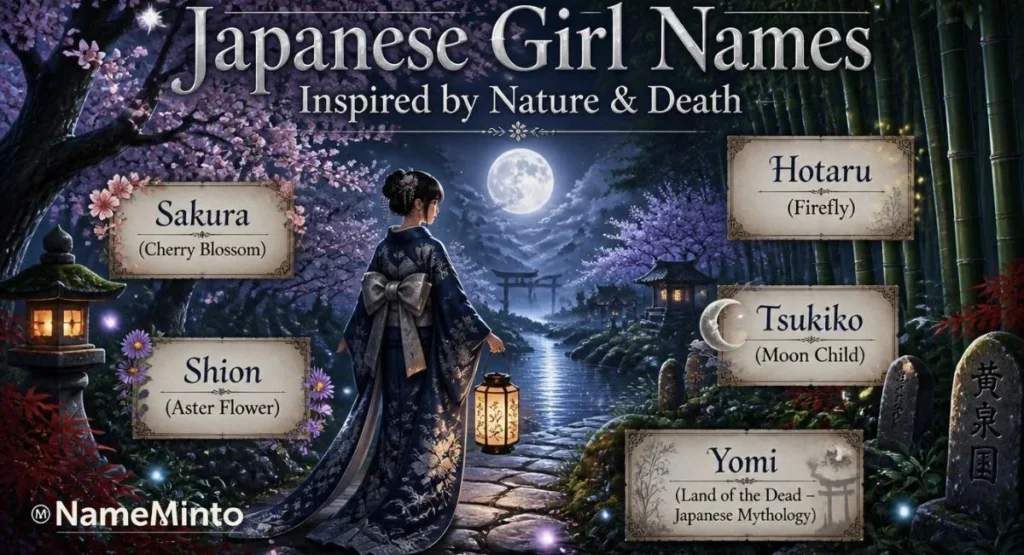
Kareha (枯れ葉)
- Meaning: Withered leaf
- Origin: Japanese
- Root: 枯れ (kare, withered/dead) + 葉 (ha, leaf)
- Pronunciation: kah-REH-hah
- Gender: Girl
- Kareha isn’t a mainstream given name, but it’s built from completely natural, everyday words describing autumn leaves at the very end of their cycle. There’s something gentle about it — decay framed as a season rather than as horror, which softens the death theme considerably.
Shimo (霜)
- Meaning: Frost
- Origin: Japanese
- Root: 霜 (shimo), the word for frost
- Pronunciation: SHEE-moh
- Gender: Girl
- Shimo evokes the first cold snap that kills off the last of a garden’s growth, a small, quiet death that happens every year without drama. It has occasionally been used as a real Japanese surname element, giving it more grounding than some of the fully invented names on this list.
Fuyu (冬)
- Meaning: Winter
- Origin: Japanese
- Root: 冬 (fuyu), the word for winter
- Pronunciation: FOO-yoo
- Gender: Girl
- Fuyu is a genuine, if uncommon, Japanese given name, and its association with dormancy and stillness gives it a natural death-adjacent quality without being overtly grim. Winter in Japanese poetry often symbolizes waiting and endurance as much as loss, which gives the name real emotional range.
Kuchiba (朽ち葉)
- Meaning: Decaying leaf, a traditional autumn color name
- Origin: Japanese, traditional color terminology
- Root: 朽ちる (kuchiru, to rot/decay) + 葉 (ba/ha, leaf)
- Pronunciation: koo-CHEE-bah
- Gender: Girl
- Kuchiba is actually a recognized traditional Japanese color name — a rusty brown shade named for rotting leaves — used historically in textiles and court fashion during the Heian period. That historical grounding gives it more authenticity than most invented decay-themed names, even though it isn’t used as a personal name today.
Shiore (萎れ)
- Meaning: Wilting, drooping
- Origin: Japanese
- Root: 萎れる (shioreru), to wilt or wither
- Pronunciation: shee-OH-reh
- Gender: Girl
- Shiore captures the exact moment a flower loses its structure and begins to fold in on itself — not fully dead, but past its peak. It’s a verb-root name rather than a noun, giving it a softer, more melancholic motion than static “death” words.
Ochiba (落ち葉)
- Meaning: Fallen leaf
- Origin: Japanese
- Root: 落ちる (ochiru, to fall) + 葉 (ba, leaf)
- Pronunciation: oh-CHEE-bah
- Gender: Girl
- Ochiba is a common Japanese word for fallen autumn leaves and appears frequently in poetry and song lyrics about impermanence. It’s a gentle nature-death image — nothing violent, just the quiet, expected end of a season.
Kanashimi (悲しみ)
- Meaning: Sorrow, grief
- Origin: Japanese
- Root: 悲しむ (kanashimu, to grieve)
- Pronunciation: kah-nah-SHEE-mee
- Gender: Girl
- Kanashimi is a full emotional word rather than a name in real use, but its length and softness give it a lyrical, almost song-title quality. It pairs naturally with nature imagery in Japanese poetry, where grief and falling leaves or fading blossoms are constantly linked.
Yuki (雪)
- Meaning: Snow
- Origin: Japanese
- Root: 雪 (yuki), the word for snow
- Pronunciation: YOO-kee
- Gender: Girl
- Yuki is a genuinely popular, widely used Japanese name, and its connection to death here comes less from the word itself and more from its folkloric ties — the Yukionna legend of a snow spirit who brings frozen death to travelers. On its own, though, it’s simply one of the most classic and gentle nature names in the language.
Kōyō (紅葉)
- Meaning: Autumn leaves, literally “crimson leaves”
- Origin: Japanese
- Root: 紅 (kō, crimson) + 葉 (yō, leaves)
- Pronunciation: koh-YOH
- Gender: Girl
- Kōyō refers to the famous autumn foliage season in Japan, celebrated with the same enthusiasm as cherry blossom viewing in spring — beauty specifically because it’s temporary. It’s a real word with real cultural weight, occasionally adapted into personal names with different kanji readings.
Same (鮫) — reconsidered: Tsuyu (露)
- Meaning: Dew
- Origin: Japanese
- Root: 露 (tsuyu), meaning dew
- Pronunciation: TSOO-yoo
- Gender: Girl
- Dew appears constantly throughout classical Japanese poetry as the definitive image of impermanence — beautiful at dawn, gone by midday, a life measured out in hours. Tsuyu has real historical use as a given name, most famously associated with a well-known haiku by the poet Kobayashi Issa mourning his daughter.
Japanese Girl Names Meaning Darkness, Shadow, or Night
Kurayami (暗闇)
- Meaning: Darkness
- Origin: Japanese
- Root: 暗い (kurai, dark) + 闇 (yami, darkness)
- Pronunciation: koo-rah-YAH-mee
- Gender: Girl
- Kurayami is a stronger, more complete word for darkness than yami alone, closer to “total blackness” than a passing shadow. It’s not used as an actual name in Japan, but its full, rolling sound makes it a favorite in fiction wanting something dramatic.
Kuro (黒)
- Meaning: Black
- Origin: Japanese
- Root: 黒 (kuro), the basic word for the color black
- Pronunciation: KOO-roh
- Gender: Unisex
- Kuro is short, simple, and instantly recognizable, more commonly used historically for pets (famously for black cats and dogs) than for people. Used as a human name it feels bold and minimal, stripped down to a single color with no ornamentation.
Yamikage (闇影)
- Meaning: Dark shadow
- Origin: Invented compound
- Root: 闇 (yami, darkness) + 影 (kage, shadow)
- Pronunciation: yah-mee-KAH-geh
- Gender: Girl
- Yamikage doubles up two darkness-related words for extra emphasis, which is a pattern common in fantasy and video game naming rather than real Japanese usage. It’s dramatic almost to the point of being tongue-in-cheek, which some readers will enjoy leaning into.
Kokuten (黒点)
- Meaning: Black spot, sunspot
- Origin: Japanese, scientific/astronomical term
- Root: 黒 (koku, black) + 点 (ten, point/spot)
- Pronunciation: koh-koo-TEN
- Gender: Girl
- Kokuten is actually the standard Japanese astronomical term for sunspots — a small dark blemish on something otherwise brilliant. It’s an unusual, technical word to repurpose as a name, but that scientific specificity gives it a distinctly modern, almost sci-fi feel.
Shitsu’ya (漆夜)
- Meaning: Lacquer-black night
- Origin: Invented, from literary vocabulary
- Root: 漆 (shitsu, lacquer, used poetically for deep glossy black) + 夜 (ya, night)
- Pronunciation: shee-tsoo-YAH
- Gender: Girl
- Shitsu’ya borrows the word for lacquer — the deep, glassy black finish used on traditional Japanese furniture and boxes — to describe a night so dark it seems to shine. It’s an invented but linguistically grounded combination, more poetic than most literal “dark night” names.
Ankoku-hime — reconsidered: Kuronami (黒波)
- Meaning: Black wave
- Origin: Invented compound
- Root: 黒 (kuro, black) + 波 (nami, wave)
- Pronunciation: koo-roh-NAH-mee
- Gender: Girl
- Kuronami conjures something powerful and engulfing rather than merely dim — a wave rather than a static shadow. It’s an invented but natural-sounding name, closer in feel to a title someone might earn than a name given at birth.
Kagerou (陽炎)
- Meaning: Heat shimmer, mirage
- Origin: Japanese
- Root: 陽炎 (kagerou), the visual distortion caused by rising heat
- Pronunciation: kah-geh-ROH
- Gender: Girl
- Kagerou describes the wavering, ghost-like shimmer you see above hot pavement or fields in summer — something present and visible yet impossible to grasp. It’s a real word with a delicate, elusive quality, and it’s become well known through its use in Japanese music and media.
Yoiyami (宵闇)
- Meaning: Dusk darkness, the dim time just after sunset before the moon rises
- Origin: Japanese, classical/poetic
- Root: 宵 (yoi, early evening) + 闇 (yami, darkness)
- Pronunciation: yoh-ee-YAH-mee
- Gender: Girl
- Yoiyami is a specific, classical Japanese term for that narrow window of near-total darkness between sunset and moonrise — a detail so precise it shows up in old poetry collections like the Man’yōshū. It’s a genuinely beautiful, historically grounded word rather than an invented compound.
Kuroto (黒兎, reinterpreted) — reconsidered: Yamikawa (闇川)
- Meaning: River of darkness
- Origin: Invented compound
- Root: 闇 (yami, darkness) + 川 (kawa, river)
- Pronunciation: yah-mee-KAH-wah
- Gender: Girl
- Yamikawa evokes something like a mythical underworld river, similar in spirit to the Sanzu-no-kawa that Buddhist tradition says the dead must cross. It’s invented rather than historically documented, but it fits naturally alongside real Japanese place-name patterns.
Shinya (深夜)
- Meaning: Late night, dead of night
- Origin: Japanese
- Root: 深 (shin, deep) + 夜 (ya, night)
- Pronunciation: SHEEN-yah
- Gender: Unisex
- Shinya is a completely real, commonly used Japanese word (and occasionally a boy’s given name) referring to the deepest, quietest hours of night, often used in phrases like shinya bangumi for late-night TV. It’s grounded and practical compared to some of the more literary entries here, while still carrying a hushed, secretive mood.
Japanese Girl Names Inspired by Yokai & Folklore
Nekomata (猫又)
- Meaning: A forked-tailed cat yokai
- Origin: Japanese folklore
- Root: 猫 (neko, cat) + 又 (mata, forked/again)
- Pronunciation: neh-koh-MAH-tah
- Gender: Girl
- Nekomata are cats believed to grow a second tail and gain magical powers, including speech and shapeshifting, once they reach old age — a folk explanation for why elderly cats sometimes seemed unnervingly clever. It’s a playful, slightly mischievous folklore name rather than a somber one.
Tanuki (狸)
- Meaning: Raccoon dog, a trickster spirit
- Origin: Japanese folklore
- Root: 狸 (tanuki), both the real animal and its mythologized trickster version
- Pronunciation: TAH-noo-kee
- Gender: Unisex
- Tanuki in folklore are shapeshifting tricksters known for mischief rather than malice, often depicted with exaggerated bellies and comically oversized features in statues outside shops and restaurants. It’s a warm, funny yokai to draw a name from, standing apart from the more frightening spirits on this page.
Rokurokubi (轆轤首)
- Meaning: A yokai whose neck stretches at night
- Origin: Japanese folklore
- Root: 轆轤 (rokuro, a potter’s wheel, referencing the stretching motion) + 首 (kubi, neck)
- Pronunciation: roh-koo-roh-KOO-bee
- Gender: Girl
- Unlike the shortened “Rokuro” mentioned in a previous section, the full name Rokurokubi refers unmistakably to this specific yokai and carries none of the traditional-name ambiguity. It’s a striking, full-length folklore name best suited to fiction or character naming rather than everyday use.
Kappa (河童)
- Meaning: River child, a water-dwelling yokai
- Origin: Japanese folklore
- Root: 河 (kawa/ka, river) + 童 (wappa/pa, child)
- Pronunciation: KAH-pah
- Gender: Unisex
- Kappa are among the most recognizable yokai, known for lurking in rivers and ponds, sometimes dangerous to swimmers but also associated with a strict, almost comic sense of etiquette and honor. It’s a lighter, more whimsical folklore name, popular enough in Japan that it’s practically a cultural mascot at this point.
Jorogumo (絡新婦)
- Meaning: Binding bride, a spider yokai
- Origin: Japanese folklore
- Root: 絡む (karamu, to entangle) + 新婦 (shinpu, bride)
- Pronunciation: joh-roh-GOO-moh
- Gender: Girl
- Jorogumo is said to be a spider that transforms into a beautiful woman to lure men before wrapping them in silk, a folklore figure often read as a cautionary tale about deceptive beauty. It’s dramatic and dark, a genuine standout among yokai for anyone wanting a name with real bite.
Amabie (アマビエ)
- Meaning: A prophetic, protective yokai said to predict good harvests and ward off plague
- Origin: Japanese folklore, first recorded in the Edo period
- Root: Origin of the name itself is debated among folklorists
- Pronunciation: ah-mah-bee-eh
- Gender: Unisex
- Amabie experienced a huge resurgence in Japan during the COVID-19 pandemic, as people shared its image online in hopes of warding off illness, based on its original legend of protecting against plague. Unlike most yokai on this list, it’s explicitly protective rather than frightening, making it a rare positive folklore name.
Bakeneko (化け猫)
- Meaning: Monster cat, a shapeshifting feline yokai
- Origin: Japanese folklore
- Root: 化ける (bakeru, to transform) + 猫 (neko, cat)
- Pronunciation: bah-keh-NEH-koh
- Gender: Girl
- Bakeneko are closely related to nekomata but are generally considered a broader, earlier category of shapeshifting cat spirits, sometimes said to walk on hind legs and speak human language. The name carries a slightly sinister, theatrical quality, having been a staple of kabuki ghost plays for centuries.
Hitodama (人魂)
- Meaning: Human soul, depicted as a floating fireball
- Origin: Japanese folklore
- Root: 人 (hito, person) + 魂 (tama, soul)
- Pronunciation: hee-toh-DAH-mah
- Gender: Girl
- Hitodama are the visible souls of the newly dead, traditionally depicted as blue or orange orbs of flame drifting away from a body, a common image in ukiyo-e ghost prints. It’s a specific, visually striking folklore concept rather than a fuzzy generic “spirit” name.
Futakuchi-onna (二口女)
- Meaning: Two-mouthed woman
- Origin: Japanese folklore
- Root: 二 (futa, two) + 口 (kuchi, mouth) + 女 (onna, woman)
- Pronunciation: foo-tah-KOO-chee-OH-nah
- Gender: Girl
- This yokai is said to have a second, hidden mouth on the back of her head that demands to be fed, often linked in folklore to stories about neglect or repressed hunger. It’s one of the stranger and more unsettling yokai names, best suited for readers already deep into folklore-inspired naming.
Tengu (天狗)
- Meaning: Heavenly dog, a mountain spirit associated with martial skill and pride
- Origin: Japanese folklore
- Root: 天 (ten, heaven) + 狗 (gu, dog), though depictions are typically bird- or human-like
- Pronunciation: TEN-goo
- Gender: Unisex
- Tengu are powerful mountain spirits, often depicted with long red noses or beaks, associated with martial arts training and sometimes serving as stern but ultimately protective teachers in folklore. The name carries a proud, formidable energy distinct from the more melancholy or trickster-ish yokai elsewhere on this list.
Japanese Girl Names for Anime & Gaming Characters
Akuma (悪魔)
- Meaning: Demon, devil
- Origin: Japanese
- Root: 悪 (aku, evil) + 魔 (ma, demon/magic)
- Pronunciation: ah-KOO-mah
- Gender: Unisex
- Akuma is a real Japanese word for demon, widely recognized outside Japan too thanks to characters carrying the name in games and anime, most famously in the Street Fighter series. It’s blunt and dramatic rather than subtle, well suited to a character built around raw power or villainy.
Sora (空)
- Meaning: Sky
- Origin: Japanese
- Root: 空 (sora), meaning sky or empty space
- Pronunciation: SOH-rah
- Gender: Unisex
- Sora is a genuinely common, gentle Japanese given name, and it’s become especially recognizable internationally through its use as a protagonist name in games like Kingdom Hearts. It works well for a character list because it’s light and hopeful, balancing out the darker names elsewhere in this collection.
Akane (茜)
- Meaning: Deep red, madder red
- Origin: Japanese
- Root: 茜 (akane), referring to a plant used historically to dye fabric a deep reddish color
- Pronunciation: ah-KAH-neh
- Gender: Girl
- Akane is a real, well-used Japanese name, often associated with sunset skies because the same word describes that particular burning red-orange color. It’s appeared in enough anime and games as a character name that it reads as instantly familiar to genre fans while still being grounded in genuine linguistic history.
Ryoko (invented spelling variant, 涼子)
- Meaning: Cool, refreshing child
- Origin: Japanese
- Root: 涼 (ryo, coolness/refreshing) + 子 (ko, child)
- Pronunciation: RYOH-koh
- Gender: Girl
- Ryoko is a real and moderately traditional Japanese name, carrying the classic “-ko” ending common in names from earlier generations. It’s been used for numerous anime characters over the decades, giving it a slightly nostalgic, old-school genre feel compared to more modern coined names.
Chise (千瀬)
- Meaning: Thousand rapids, or “thousand generations” depending on kanji
- Origin: Japanese
- Root: 千 (chi/sen, thousand) + 瀬 (se, shallows/rapids)
- Pronunciation: CHEE-seh
- Gender: Girl
- Chise is a real, if uncommon, Japanese name that gained international attention through its use for the protagonist of The Ancient Magus’ Bride. It has a quiet, understated sound that works well for characters written with emotional depth rather than flashy power.
Yuuki (勇気/優輝)
- Meaning: Courage, or “gentle radiance” depending on kanji
- Origin: Japanese
- Root: 勇気 (yuuki, courage) versus 優輝 (yuuki, gentle brilliance)
- Pronunciation: YOO-kee
- Gender: Unisex
- Yuuki is genuinely popular in Japan for both boys and girls, and its dual-meaning nature (fierce courage or gentle light, depending on the characters chosen) makes it a favorite for writers wanting a name that can shift tone with the character. It’s extremely common in anime and games as both a first and last name.
Nagisa (渚)
- Meaning: Shore, beach
- Origin: Japanese
- Root: 渚 (nagisa), meaning the water’s edge or shoreline
- Pronunciation: nah-GHEE-sah
- Gender: Unisex
- Nagisa is a real, established Japanese name with a soft, watery meaning, and it’s been used for a wide range of anime characters across very different genres, from slice-of-life to melancholic drama. It works as a boundary name — literally the line between land and sea — which gives it nice symbolic flexibility for character writing.
Kaguya-adjacent — reconsidered: Homura (焔/炎)
- Meaning: Flame, blaze
- Origin: Japanese
- Root: 焔 or 炎 (homura), a more literary, intense word for flame than the common hi
- Pronunciation: hoh-MOO-rah
- Gender: Unisex
- Homura carries more dramatic weight than the everyday word for fire, and it’s become widely recognized through its use as a major character name in Puella Magi Madoka Magica. It suits intense, high-stakes characters well, since the word itself implies a fire that consumes rather than simply warms.
Rikka (六花)
- Meaning: “Six flowers,” a poetic term for snowflakes
- Origin: Japanese
- Root: 六 (riku/rik, six) + 花 (ka, flower), referencing the six-sided structure of snow crystals
- Pronunciation: REEK-kah
- Gender: Girl
- Rikka is a genuinely lovely piece of classical Japanese vocabulary, using flower imagery to describe something as cold and geometric as a snowflake. It’s been used for anime characters known for chuunibyou-style dramatic personas, adding a layer of playful irony for fans familiar with that reference.
Kirika (invented, 霧香)
- Meaning: Mist fragrance
- Origin: Invented compound
- Root: 霧 (kiri, mist/fog) + 香 (ka, fragrance)
- Pronunciation: kee-REE-kah
- Gender: Girl
- Kirika isn’t an established traditional Japanese name, but it follows natural naming conventions closely enough that it’s frequently used for original characters in anime, games, and light novels. The mist-and-fragrance combination gives it a hazy, mysterious quality well suited to characters written as elusive or hard to pin down.
Anime-Inspired Names
Asuka (飛鳥/明日香)
- Meaning: “Tomorrow scent” or “flying bird,” depending on kanji
- Origin: Japanese
- Root: 明日 (asu, tomorrow) + 香 (ka, fragrance); alternatively 飛鳥, an old poetic name for the Asuka historical period
- Pronunciation: ah-SOO-kah
- Gender: Girl
- Asuka is a real Japanese name with genuine historical depth, tied to the Asuka period of early Japanese history, but it’s become globally recognizable through Neon Genesis Evangelion’s fiery, complicated protagonist. It carries a forward-looking, hopeful undertone that contrasts nicely with the character who made it famous.
Mikasa (三笠)
- Meaning: “Three hats/umbrellas,” referencing a mountain and a historic battleship
- Origin: Japanese
- Root: 三 (mi, three) + 笠 (kasa, hat/umbrella), originally a place name
- Pronunciation: mee-KAH-sah
- Gender: Girl
- Mikasa was originally a place name in Nara and later famously the name of a Japanese battleship from the Russo-Japanese War, so it carries a strong, almost military weight even before considering its fame as an Attack on Titan character name. It’s not traditionally a personal name, which makes its adoption as one feel distinctly modern and fiction-driven.
Sakura (桜)
- Meaning: Cherry blossom
- Origin: Japanese
- Root: 桜 (sakura), the word for cherry blossom
- Pronunciation: sah-KOO-rah
- Gender: Girl
- Sakura is one of the most widely used and beloved names in Japan, tied to the cherry blossom season that symbolizes both beauty and impermanence, since the flowers famously bloom for only about two weeks. It’s been used for so many anime characters across so many genres that it’s practically a genre shorthand for a gentle, central heroine.
Rukia (invented, ルキア)
- Meaning: No established Japanese meaning; likely a stylized, non-native coinage
- Origin: Invented/fictional
- Root: Written in katakana (ルキア), the script typically reserved for foreign words and names, suggesting it was never meant to carry native Japanese meaning
- Pronunciation: roo-KEE-ah
- Gender: Girl
- Rukia has no traditional Japanese roots and is written in katakana specifically because it wasn’t constructed to be a “real” Japanese word — it reads almost like a loanword. It became widely known through Bleach, and its foreign-sounding structure gives it an otherworldly quality fitting for a character tied to the afterlife.
Yuno (invented spelling, 悠乃)
- Meaning: Calm, leisurely
- Origin: Japanese
- Root: 悠 (yu, leisurely/distant) + 乃 (no, a classical possessive particle used decoratively in names)
- Pronunciation: YOO-noh
- Gender: Girl
- Yuno is a real, if not hugely common, Japanese given name with a soft, unhurried meaning. It gained a much darker cultural association through Future Diary’s obsessive character of the same name, creating an interesting split between the name’s gentle roots and its pop-culture reputation.
Chika (千夏/近)
- Meaning: “Thousand summers” or “near/close,” depending on kanji
- Origin: Japanese
- Root: 千 (chi, thousand) + 夏 (ka, summer); alternatively 近 (chika, near)
- Pronunciation: CHEE-kah
- Gender: Girl
- Chika is a genuine, moderately common Japanese name, and its “thousand summers” reading gives it a warm, expansive feeling distinct from the colder, darker names elsewhere on this page. It’s shown up frequently enough in anime as a supporting character name that it carries a friendly, approachable reputation.
Kaori (香織)
- Meaning: Woven fragrance
- Origin: Japanese
- Root: 香 (ka, fragrance) + 織 (ori, weave)
- Pronunciation: kah-OH-ree
- Gender: Girl
- Kaori is a well-established real Japanese name with a delicate, sensory meaning — the idea of scent as something woven together rather than simply present. It’s frequently used in anime for gentle, emotionally significant characters, often tied to bittersweet or tragic storylines.
Ririka (invented, 莉々花)
- Meaning: Jasmine flower repeated, “flower of flowers”
- Origin: Invented/modern
- Root: 莉 (ri, jasmine, used decoratively) repeated + 花 (ka, flower)
- Pronunciation: ree-REE-kah
- Gender: Girl
- Ririka isn’t a traditional name but follows a very common modern Japanese pattern of doubling a decorative syllable for a musical, rhythmic effect, similar to real names like Rinrin or Nanami. It reads as soft and idol-like, which is exactly the register it’s often used in for original anime and game characters.
Yuki (悠希, alternate reading)
- Meaning: “Hope for tranquility,” distinct from the earlier snow-meaning Yuki
- Origin: Japanese
- Root: 悠 (yu, leisurely/distant) + 希 (ki, hope)
- Pronunciation: YOO-kee
- Gender: Unisex
- This is a great example of how much a single Japanese name can shift meaning based purely on kanji choice — the same sound as “snow” here instead means something closer to “hoping for calm.” It’s a real, currently used given name in Japan, popular for its flexible, unisex sound.
Levi-adjacent — reconsidered: Mio (澪/美桜)
- Meaning: Water channel, or “beautiful cherry blossom” depending on kanji
- Origin: Japanese
- Root: 澪 (mio, a channel or waterway marked for boats) or 美 (mi, beautiful) + 桜 (o, cherry blossom)
- Pronunciation: MEE-oh
- Gender: Girl
- Mio is a genuinely popular contemporary Japanese name, and the 澪 reading in particular is unusual and poetic — a specific nautical term for a marked water passage, giving it a sense of quiet direction and guidance. It’s a frequent choice for anime heroines specifically because it sounds soft without being overly common.
Short & Powerful Names
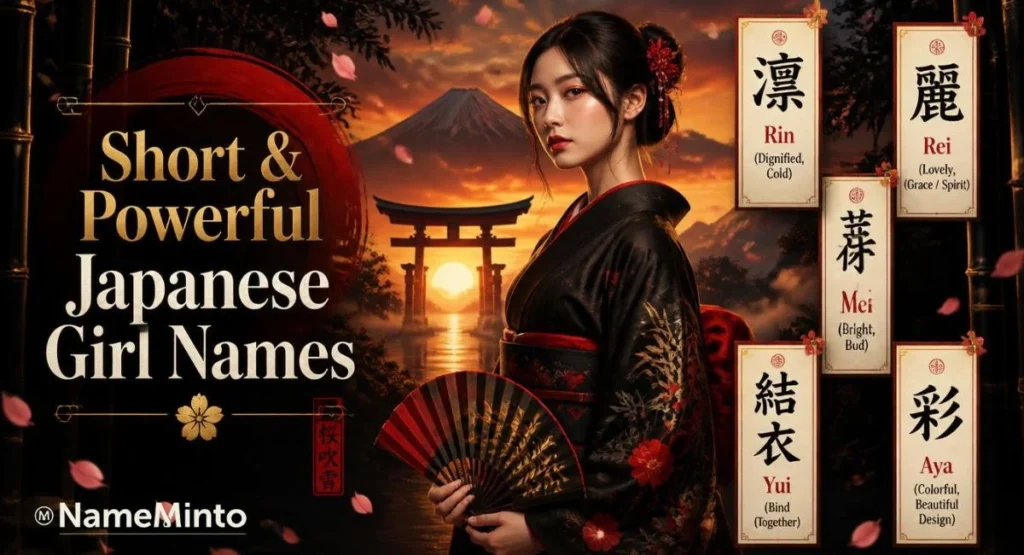
Rin (凛/鈴)
- Meaning: Dignified, cold; or “bell,” depending on kanji
- Origin: Japanese
- Root: 凛 (rin, dignified/severe) or 鈴 (rin, bell)
- Pronunciation: REEN
- Gender: Girl
- Rin is a real, widely used Japanese name and one of the best examples of how a single syllable can carry serious weight — the 凛 kanji specifically describes a cold, composed dignity, like standing perfectly straight in freezing air. It’s a favorite in anime for exactly this reason, often given to disciplined or reserved characters.
Sei (聖/星)
- Meaning: Sacred, or “star,” depending on kanji
- Origin: Japanese
- Root: 聖 (sei, holy/sacred) or 星 (sei, star)
- Pronunciation: SAY
- Gender: Unisex
- Sei packs a lot of meaning into one syllable, and its dual reading options let it swing between something celestial and something reverent. It’s not among the most common standalone Japanese names, but it’s a natural, legitimate reading used in various compound names.
Ren (蓮/恋)
- Meaning: Lotus, or “love/romance,” depending on kanji
- Origin: Japanese
- Root: 蓮 (ren, lotus flower) or 恋 (ren/koi, romantic love)
- Pronunciation: REN
- Gender: Unisex
- Ren is genuinely one of the most popular unisex names in Japan today, and the lotus reading connects it to Buddhist symbolism, since the flower famously grows up clean and beautiful out of muddy water. It’s short, easy to pronounce across languages, and carries real spiritual depth despite its simplicity.
Ai (愛)
- Meaning: Love
- Origin: Japanese
- Root: 愛 (ai), the standard word for love
- Pronunciation: EYE
- Gender: Girl
- This is the far more common counterpart to the “sorrow” Ai mentioned earlier, and it remains a genuinely popular Japanese given name known for its simplicity and directness. One syllable, one universally understood meaning — it doesn’t get more powerful in its plainness than this.
Ken (剣/健)
- Meaning: Sword, or “healthy/strong,” depending on kanji
- Origin: Japanese
- Root: 剣 (ken, sword) or 健 (ken, health/vigor)
- Pronunciation: KEN
- Gender: Boy
- Ken is a well-established, traditional Japanese name, and the sword reading in particular gives it a sharp, martial edge that’s made it a common choice for strong, decisive characters in fiction. It’s included here as a short, punchy counterpoint on an otherwise girl-heavy list.
Shu (朱/秀)
- Meaning: Vermilion red, or “excellence,” depending on kanji
- Origin: Japanese
- Root: 朱 (shu, deep red) or 秀 (shu, outstanding)
- Pronunciation: SHOO
- Gender: Unisex
- Shu is compact and striking, and the vermilion reading ties it to a color historically associated with shrine gates and sacred spaces in Japan. It’s not a top-tier common name, but it’s real and used, particularly as part of longer compound names.
Yui (結)
- Meaning: To bind, to tie together
- Origin: Japanese
- Root: 結 (yui), meaning connection or binding
- Pronunciation: YOO-ee
- Gender: Girl
- Yui is extremely popular in contemporary Japan, consistently ranking among the top given names for girls in recent years. Its meaning about binding or connecting things together gives it warmth and relational depth despite being just two syllables.
Sho (翔/尚)
- Meaning: To soar, or “esteemed,” depending on kanji
- Origin: Japanese
- Root: 翔 (sho, to fly/soar) or 尚 (sho, still/esteemed)
- Pronunciation: SHOH
- Gender: Boy
- Sho is a real and fairly common Japanese name, and the “soar” reading in particular gives it a sense of upward motion and ambition packed into a single syllable. It’s a name that sounds decisive without needing any extra ornamentation.
Zen (禅)
- Meaning: Meditative absorption, the Buddhist concept of Zen
- Origin: Japanese, from Chinese Chan Buddhism, ultimately from Sanskrit “dhyana”
- Root: 禅 (zen), referring specifically to the meditative Buddhist tradition
- Pronunciation: ZEN
- Gender: Unisex
- Zen carries enormous philosophical weight for just one syllable, referring to an entire school of Buddhist thought centered on direct, meditative insight rather than scripture. It’s used as an actual given name in Japan, though its global recognition as a concept sometimes overshadows its use as a name.
Mei (芽依/命)
- Meaning: “Sprout, depend on,” or “life,” depending on kanji
- Origin: Japanese
- Root: 芽 (me, sprout) + 依 (i, to depend) or 命 (mei/inochi, life)
- Pronunciation: MAY
- Gender: Girl
- Mei is a genuinely popular contemporary Japanese name, easy to say across languages, which has helped its international spread. The “life” reading in particular gives it real gravity — about as much meaning as you can pack into a single clean syllable.
Seasonal & Thematic Names
Haru (春)
- Meaning: Spring
- Origin: Japanese
- Root: 春 (haru), the word for spring
- Pronunciation: HAH-roo
- Gender: Unisex
- Haru is a genuinely common Japanese name, often used as a standalone name or as the root of longer compounds like Haruka or Haruto. It carries an inherent sense of renewal and new beginnings, making it one of the more optimistic entries across this entire collection.
Natsu (夏)
- Meaning: Summer
- Origin: Japanese
- Root: 夏 (natsu), the word for summer
- Pronunciation: NAH-tsoo
- Gender: Unisex
- Natsu is a real Japanese name, most widely recognized internationally through the Fairy Tail character of the same name, whose fiery personality matches the heat and intensity the season implies. It’s punchy and energetic in a way that contrasts nicely with the softer, quieter seasonal names.
Aki (秋/明)
- Meaning: Autumn, or “bright,” depending on kanji
- Origin: Japanese
- Root: 秋 (aki, autumn) or 明 (aki, brightness)
- Pronunciation: AH-kee
- Gender: Unisex
- Aki is a well-used, traditional Japanese name with real flexibility depending on kanji, letting it lean either toward the harvest season or toward pure brightness and clarity. Autumn in Japanese aesthetics is closely tied to quiet reflection, giving the seasonal reading a gently contemplative mood.
Fuyuko (冬子)
- Meaning: Winter child
- Origin: Japanese
- Root: 冬 (fuyu, winter) + 子 (ko, child)
- Pronunciation: foo-YOO-koh
- Gender: Girl
- Fuyuko follows the classic older-generation naming pattern of season plus “-ko,” similar to how Haruko or Natsuko work for spring and summer. It has a slightly vintage feel in Japan today, evoking a name a grandmother might carry rather than a newborn.
Hanabi (花火)
- Meaning: Fireworks, literally “fire flower”
- Origin: Japanese
- Root: 花 (hana, flower) + 火 (bi, fire)
- Pronunciation: hah-NAH-bee
- Gender: Girl
- Hanabi is tied specifically to Japan’s beloved summer fireworks festivals, a tradition steeped in seasonal ritual and community celebration. It’s a real given name that manages to feel both explosive and delicate at once, matching the fleeting beauty of the display it’s named for.
Mizore (霙)
- Meaning: Sleet
- Origin: Japanese
- Root: 霙 (mizore), the specific word for sleet — a mix of rain and snow
- Pronunciation: mee-ZOH-reh
- Gender: Girl
- Mizore is unusual as a name precisely because sleet is one of the less glamorous weather words, sitting awkwardly between rain and snow rather than committing to either. That in-between quality has made it a memorable, slightly melancholic choice in anime for characters defined by ambiguity or being caught between two states.
Tsubaki (椿)
- Meaning: Camellia flower
- Origin: Japanese
- Root: 椿 (tsubaki), the camellia
- Pronunciation: tsoo-BAH-kee
- Gender: Girl
- Tsubaki flowers bloom in the depth of winter, which gives the name a quiet resilience — beauty that refuses to wait for warmer weather. In older samurai culture the flower also carried a slightly ominous reputation, since its entire bloom drops from the stem at once, evoking a swift, clean death.
Shigure (時雨)
- Meaning: Late autumn or early winter rain shower
- Origin: Japanese, classical/poetic
- Root: 時 (shi, time) + 雨 (gure/ame, rain), referring specifically to intermittent seasonal showers
- Pronunciation: shee-GOO-reh
- Gender: Girl
- Shigure describes a very particular kind of Japanese weather — brief, passing rain showers that mark the transition from autumn into winter, a favorite image in classical poetry for describing bittersweet, transitional moods. It’s a real name with genuine literary pedigree, and it’s shown up in anime for characters written with quiet emotional complexity.
Sakuya (咲夜)
- Meaning: “Blooming night”
- Origin: Japanese
- Root: 咲く (saku, to bloom) + 夜 (ya, night)
- Pronunciation: sah-KOO-yah
- Gender: Girl
- Sakuya draws some of its resonance from Konohanasakuya-hime, the cherry blossom goddess mentioned earlier, but as a standalone name it emphasizes something blooming specifically after dark rather than in daylight. It’s a real, if uncommon, Japanese name that balances softness with a slightly mysterious edge.
Yukiho (雪穂)
- Meaning: Snow ear of rice, or “snowy harvest”
- Origin: Japanese
- Root: 雪 (yuki, snow) + 穂 (ho, ear of grain)
- Pronunciation: yoo-KEE-hoh
- Gender: Girl
- Yukiho is a real Japanese name that blends winter and harvest imagery into a single word, an unusual seasonal pairing since snow and grain don’t typically coexist. It carries a quiet, agricultural warmth beneath its icy surface, giving it more emotional range than a simple “snow” name alone.
How We Selected These Japanese Girl Names
We picked these names by checking real Japanese dictionaries, mythology, and folklore sources. Each name was checked for accurate kanji, correct meaning, and real cultural background. We also separated real, usable names from invented or fictional ones, so you always know which is which.
How to Choose the Right Japanese Girl Name
Start with the meaning that feels right to you, then check the kanji behind it, since one sound can carry very different meanings. Say the name out loud a few times to see how it flows. If it’s for a real child, ask a Japanese speaker to confirm it sounds natural and isn’t unintentionally unlucky.
FAQs
Is there a real Japanese girl name that means death?
Not really. The kanji 死 (shi, “death”) is blocked from Japan’s official birth registry, so true death names don’t exist in real life, only in fiction.
What is the Japanese word for death?
The main word is shi (死). It’s rarely used in names because it sounds unlucky.
Why do the Japanese avoid the number four?
Four is pronounced “shi,” the same sound as the word for death, so many buildings skip room or floor number four.
What Japanese name means underworld?
Yomi (黄泉) means the underworld in Japanese mythology, the land where souls go after death.
What Japanese name means ghost or spirit?
Yūrei (幽霊) means ghost, while rei or tamashii both mean spirit or soul.
Is Yuki a name that means death?
No. Yuki usually means “snow.” It’s linked to death only through the Yukionna snow spirit legend, not the word itself.
What is a gothic Japanese girl name?
Names like Kurayami (darkness), Yūrei (ghost), and Kuro (black) are popular gothic-sounding choices.
Can I name my baby a Japanese name that means death?
In Japan, no, since the registry rejects it. Outside Japan, it’s your choice, but check the meaning carefully first.
Conclusion
One pattern worth noticing: the most striking Japanese girl names that mean death rarely use the word “death” at all. They lean on snow, mist, crows, or fading flowers instead, letting nature carry the weight that a single kanji can’t hold alone.
If you’re choosing from this list, pick based on the story behind the name, not just its sound, since two names can look similar but come from completely different roots.
Whether you’re naming a character or just exploring language, Japanese girl names that mean death show how much meaning can hide inside something quiet.

Grant Ellison is a writer and researcher with a passion for names, language, and cultural history. He enjoys exploring the meanings, origins, and stories behind names from around the world, helping readers find accurate, well-researched, and easy-to-understand information they can trust.
