

Quick Answer: “Vendor” is the correct spelling. It refers to a person or company that sells goods or services. “Vender” is a rare, outdated variant found only in historical texts it’s not a verb, despite what some articles claim. Use vendor in every business, legal, or professional context.
Even The New Yorker spells it “vender,” and that one exception has confused writers for decades. But outside that magazine’s house style, dictionaries, contracts, and business emails all agree on a single answer to vender or vendor.
Get this wrong in a client proposal or an RFP, and it reads as a typo, not a style choice. This guide clears up the vendor or vender debate for good, backed by dictionary sources, real writing examples, and one trick you’ll never forget.
Vendor vs Vender : Key Takeaways
- Vendor is the only spelling accepted in modern business, legal, and academic writing.
- Vender exists in old dictionaries, but it’s considered rare and outdated today.
- Vendor is not just correct in the US. It’s also the standard spelling in the UK and every other English speaking country.
- Vendor refers to a person or company that sells goods or services, from a street food seller to a large software company.
- If you’re unsure which one to type, always choose vendor. It’s never wrong.
What Do Dictionaries Say? (Merriam-Webster, Oxford, Cambridge)
Merriam-Webster lists vendor as the main entry, defined simply as “one that vends: seller.” It marks vender as a “less commonly” used variant, not a separate word.
Cambridge Dictionary defines vendor as “someone who is selling something.” Its vender entry exists too, but it simply redirects back to vendor.
Oxford Learner’s Dictionary confirms the same pattern, tracing vendor to Anglo-Norman French and Latin “vendere.”
All three agree: vendor is the standard entry, vender is the redirect.
Why People Think “Vender” Is a Verb (Myth Busting)

Here’s something a lot of grammar sites get wrong: they claim vender is a verb meaning “to sell,” as in “street sellers vender snacks near schools.” That’s simply not true.
Vender has never been a standard English verb. There’s no dictionary, style guide, or grammar authority that supports using it that way. The confusion likely comes from mixing it up with vend, which is a real verb (as in a vending machine “vends” snacks).
So where does the myth come from? Vender looks like it could be a verb because of the “er” ending, similar to words like “answer” or “enter.” But in reality, vender is only ever a noun, and even that use is rare and outdated.
The bottom line: if you want a verb related to selling, use “sell” or “vend.” Never “vender.”
Word Origin From Latin “Vendere”

Both vendor and vender come from the same Latin root: vendere, meaning “to sell.” The spelling split happened later, not at the root.
Vendor was borrowed whole from Anglo-French in the 1590s, ready-made from Latin “venditor” (seller).
Vender was built inside English the same decade, by adding “-er” to the verb “vend,” the same way “teach” becomes “teacher.”
Same Latin ancestor, two different paths. The borrowed legal term, vendor, became the standard. The homemade version, vender, faded into rare use.
American English vs British English
| Aspect | American English | British English |
| Standard spelling | Vendor | Vendor |
| Rare/historical variant | Vender | Vender |
| Business writing | Vendor | Vendor |
| Legal documents | Vendor | Vendor |
| Everyday speech | Vendor | Vendor |
There’s no split here like you’d see with “color” vs “colour.” Both American and British English use vendor. If you’ve heard someone say vender is the British spelling, that’s a myth. It isn’t tied to any dialect. It’s just an old, uncommon variant.
Vendor vs Related Words
Vendor vs Supplier
A vendor sells directly to the end customer, often in smaller amounts. A supplier provides goods to businesses, usually in bulk, further back in the supply chain.
❌ Incorrect: Our supplier at the farmers market sells fresh honey.
✅ Correct: Our vendor at the farmers market sells fresh honey.
Vendor vs Contractor
A vendor sells products or services. A contractor is hired under a contract to complete a specific job, usually in construction, consulting, or freelance work.
❌ Incorrect: We hired a vendor to renovate our kitchen.
✅ Correct: We hired a contractor to renovate our kitchen.
Vendor vs Vendee
A vendor is the seller in a transaction. A vendee is the buyer. These terms show up together most often in property and legal contracts.
❌ Incorrect: The vendee listed the house for sale.
✅ Correct: The vendor listed the house for sale.
Vendor vs Seller
Seller is a general term for anyone who sells something. Vendor is more formal and often used in business, retail, or contract settings.
❌ Incorrect: Amazon works with thousands of third party contractors.
✅ Correct: Amazon works with thousands of third party vendors.
Correct vs Incorrect Examples
| Context | Incorrect ❌ | Correct ✅ |
| Business email | Please contact our vender for updates. | Please contact our vendor for updates. |
| Retail | The food vender sells great tacos. | The food vendor sells great tacos. |
| Contracts | The vender must deliver goods by Friday. | The vendor must deliver goods by Friday. |
| Social media | Check out this amazing vender at the fair! | Check out this amazing vendor at the fair! |
| Software/tech | We’re switching to a new software vender. | We’re switching to a new software vendor. |
Common Mistakes to Avoid
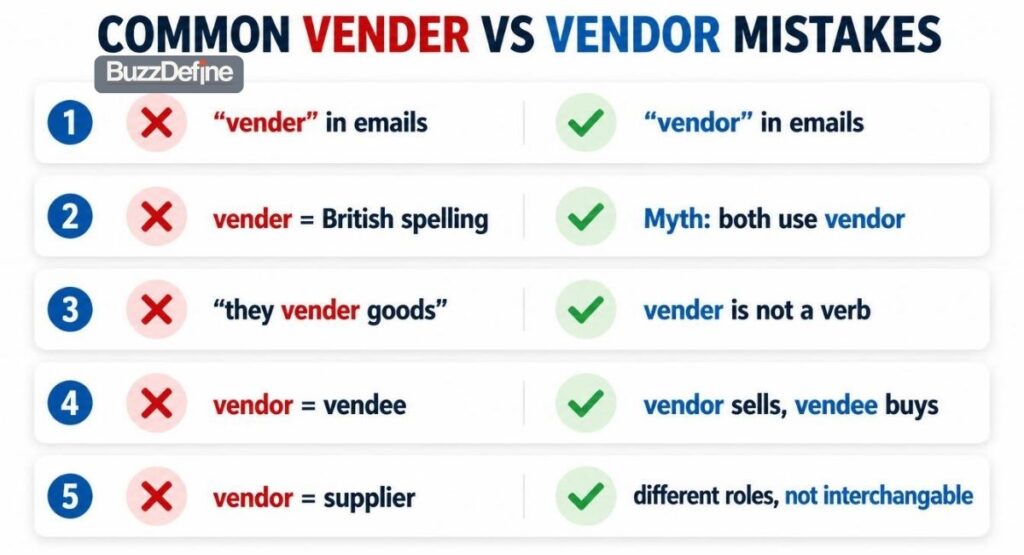
- Writing “vender” in business emails or contracts. It reads as a typo, even though it’s technically an old word.
- Assuming vender is a British spelling. It isn’t. Both American and British English use vendor.
- Using “vender” as a verb, like “they vender goods.” Vender is not a verb in modern English.
- Confusing vendor with vendee. Vendor sells, vendee buys.
- Mixing up vendor and supplier in formal writing. They aren’t interchangeable, even though they’re related.
Memory Trick to Never Confuse Again
Here’s an easy way to lock it in: think of a vending machine. It has an “O,” and so does the person who sells from one, a vendor.
Another trick: vendor rhymes with actor, editor, and creator, all words for someone who does something. Vender doesn’t fit that pattern, which is your signal that it’s the odd one out.
If you ever stop and think “wait, is it er or or?” just picture the vending machine. That “O” is your answer.
Quick Interactive Quiz
Test yourself with these quick questions. Answers are right below each one.
1. Which spelling is correct in modern English?
A) Vender B) Vendor
Answer: B. Vendor is the standard spelling in all contexts.
2. True or false: Vender is the British spelling of vendor.
Answer: False. Both American and British English use vendor.
3. Fill in the blank: We need a new software ___ for our company.
A) vender B) vendor
Answer: B. Vendor is correct here.
4. Is “vender” a real verb meaning “to sell”?
Answer: No. Vender is only ever a noun, and it’s rarely used today.
5. Who is the buyer in a vendor and vendee agreement?
Answer: The vendee. The vendor is the seller.
FAQs
Is it vender or vendor?
Vendor is the correct spelling. Vender is a rare, outdated variant that’s no longer used in standard English.
Is vender a real word?
Yes, but it’s archaic and almost never used today. Stick with vendor in all modern writing.
What does vendor mean?
A vendor is a person or company that sells goods or services, from street sellers to large software companies.
Is vender British English?
No. Both British and American English use vendor as the standard spelling.
Can vender be used as a verb?
No. Vender has never been a standard verb in English. Use “sell” or “vend” instead.
What’s the difference between vendor and supplier?
A vendor sells directly to customers. A supplier provides goods to businesses, usually in bulk.
What’s the difference between vendor and vendee?
Vendor is the seller. Vendee is the buyer. These terms are common in legal and property contracts.
Should I use vendor in business emails?
Yes, always use vendor. Vender can look like a typo and may seem unprofessional.
Conclusion
Vendor is the spelling you should always use, whether you’re writing an email, a contract, or a social media post. Vender still exists, but it’s rare, outdated, and easy to skip entirely.
Stick to vendor, and you’ll never second guess your spelling again.
Read Next : Parent’s or Parents’? The Correct Grammar Rule Explained

Grant Ellison is an English language writer and editor with a passion for making grammar, word meanings, and everyday expressions easy to understand. He researches trusted language references and creates clear, accurate content that helps readers improve their English with confidence.
