

Quick Answer: “Thank you for the opportunity” is a polite, professional phrase, but it’s overused. Better alternatives include “I appreciate the opportunity,” “I’m grateful for the opportunity,” and “Thank you for trusting me with this” each suited to different situations like interviews, promotions, or mentorship.
Saying “thank you for the opportunity” gets the job done but it’s the most overused line in professional English. Recruiters read it in every interview follow-up. Managers see it in every promotion reply. If you want to actually stand out, you need phrases that sound like you, not a template.
This guide gives you 70+ professional thank you phrases, organized by real situations interviews, job offers, promotions, mentorship, and more plus ready-to-copy email templates so you’re never stuck staring at a blank subject line.
Is “Thank You for the Opportunity” Professional?
Yes. It’s grammatically correct, polite, and works in almost any formal setting. But because it’s so common, it can read as generic or scripted, especially in interview follow-ups and job offer replies.
Using a more specific alternative one that names what you’re grateful for makes your message feel sincere instead of copy-pasted.
Quick Reference Table
| Phrase | Tone | Best For |
| I appreciate the opportunity | Neutral/Formal | Emails, interviews |
| I’m grateful for the opportunity | Warm/Sincere | Mentorship, reflective notes |
| Thank you for believing in me | Personal/Sincere | Promotions, leadership trust |
| I appreciate the trust you’ve placed in me | Formal/Mature | Leadership roles |
| Thank you for giving me this chance | Casual/Sincere | Interviews, mentorship |
| I’m honored by this opportunity | Formal/Respectful | High-stakes offers |
| Thank you for the learning opportunity | Warm/Growth-focused | Internships, training |
| I appreciate being considered | Neutral/Formal | Job applications |
| Thank you for trusting me with this | Formal/Accountable | Project ownership |
| I sincerely appreciate this opportunity | Formal/Strong | Closing lines, high-stakes emails |
When & Why This Phrase Feels Overused
“Thank you for the opportunity” shows up so often that readers barely register it anymore. Here’s why it loses impact — and when to swap it out.
- It’s generic. The phrase doesn’t say what you’re actually thankful for — the role, the trust, the learning, the timing.
- It’s automatic. Recruiters and managers see it in nearly every reply, so it reads as a habit, not a genuine reaction.
- It hides your personality. A specific phrase tells someone you thought about their offer, not just any offer.
- It can undersell a big moment. A major promotion or a hard-won project deserves more than a stock line.
Use an alternative when: you want to sound specific, personal, or memorable — especially in interviews, offers, and mentorship messages.
Stick with the original when: you need a short, safe, universally-understood response and don’t have time to personalize it.
70+ Other Ways to Say “Thank You for the Opportunity”
Interview Follow Up
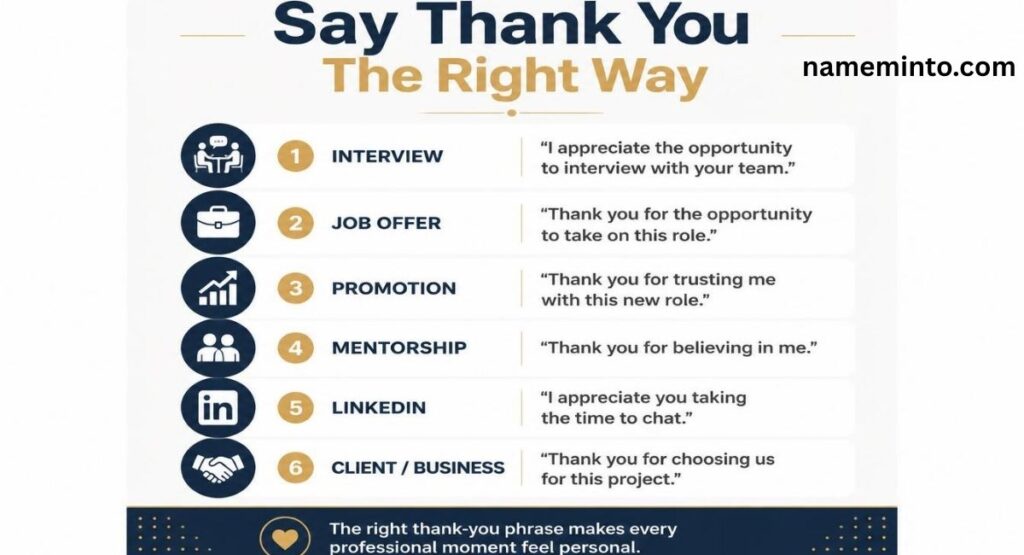
1. I appreciate the opportunity to interview with your team.
- Meaning: Thanks the interviewer for the time and consideration.
- Tone: Formal
- Best Use: Follow up email right after the interview.
- Avoid When: You already used this exact line in the interview itself.
- Example: “I appreciate the opportunity to interview with your team and learn more about the role.”
2. Thank you for considering my application.
- Meaning: Acknowledges you’re still in the running.
- Tone: Neutral, Formal
- Best Use: Early stage applications, before an interview is confirmed.
- Avoid When: You’ve already had multiple rounds of interviews (feels too early stage).
- Example: “Thank you for considering my application for the Marketing Coordinator role.”
3. I’m grateful for the chance to discuss this role with you.
- Meaning: Warmer version of thanking someone for interview time.
- Tone: Warm, Sincere
- Best Use: When the conversation felt personal or in depth.
- Avoid When: The interview was very short or purely procedural.
- Example: “I’m grateful for the chance to discuss this role with you and the team today.”
4. Thank you for taking the time to speak with me.
- Meaning: Focuses on the interviewer’s time, not the opportunity itself.
- Tone: Polite, Neutral
- Best Use: Panel interviews or when multiple people were involved.
- Avoid When: You want to emphasize the role itself, not just the meeting.
- Example: “Thank you for taking the time to speak with me about the design position.”
5. I appreciate the insight into your team’s work.
- Meaning: Thanks them for information shared, not just the interview slot.
- Tone: Professional, Specific
- Best Use: When the interviewer explained the role or team in detail.
- Avoid When: The interview was mostly questions to you, not information sharing.
- Example: “I appreciate the insight into your team’s current projects and goals.”
6. Thank you for this chance to prove myself.
- Meaning: Shows confidence plus humility about the next steps.
- Tone: Confident, Humble
- Best Use: Final round interviews or when you know it’s a competitive process.
- Avoid When: First round or early screening call.
- Example: “Thank you for this chance to prove myself in the final round.”
7. I truly value the opportunity to learn more about this position.
- Meaning: Frames the interview as valuable regardless of outcome.
- Tone: Reflective, Sincere
- Best Use: When you’re genuinely unsure if you’ll get the role but want to leave a good impression.
- Avoid When: You’re confident and want a stronger, more assertive tone.
- Example: “I truly value the opportunity to learn more about this position and your company’s direction.”
8. Thank you for the productive conversation today.
- Meaning: Highlights the quality of the discussion itself.
- Tone: Professional, Direct
- Best Use: When the interview felt more like a two way conversation than a Q&A.
- Avoid When: The tone of the interview was formal and one sided.
- Example: “Thank you for the productive conversation today. I’m even more excited about the role.”
Job Offer / New Role
1. I’m thankful for this professional opportunity.
- Meaning: Formal acknowledgment of accepting a new role.
- Tone: Formal, Professional
- Best Use: Written acceptance emails or contracts.
- Avoid When: You want a warmer, more personal tone.
- Example: “I’m thankful for this professional opportunity and look forward to starting on the 1st.”
2. Thank you for the opportunity to take on this role.
- Meaning: Direct gratitude tied to the specific position.
- Tone: Clear, Professional
- Best Use: Formal offer acceptance emails.
- Avoid When: The message already names the role elsewhere (avoids repetition).
- Example: “Thank you for the opportunity to take on this role. I’m ready to get started.”
3. I appreciate the opportunity to join your team.
- Meaning: Focuses on the team, not just the job title.
- Tone: Warm, Professional
- Best Use: When you’ve met the team and want to acknowledge them directly.
- Avoid When: You haven’t interacted with the team yet.
- Example: “I appreciate the opportunity to join your team and contribute from day one.”
4. Thank you for this exciting opportunity.
- Meaning: Adds enthusiasm to standard gratitude.
- Tone: Enthusiastic, Warm
- Best Use: Startups, creative roles, or informal company cultures.
- Avoid When: The company culture is very formal or corporate.
- Example: “Thank you for this exciting opportunity. I can’t wait to get started.”
5. I’m honored to accept this position.
- Meaning: Signals respect for the offer and the decision behind it.
- Tone: Formal, Respectful
- Best Use: Senior roles or highly competitive positions.
- Avoid When: Entry-level or casual workplace settings.
- Example: “I’m honored to accept this position and grateful for your confidence in me.”
6. Thank you for your confidence in my abilities.
- Meaning: Acknowledges the trust behind the hiring decision.
- Tone: Sincere, Professional
- Best Use: When the offer came after a long or competitive process.
- Avoid When: A quick, informal hire (feels overly formal).
- Example: “Thank you for your confidence in my abilities. I won’t let the team down.”
7. I appreciate the opportunity to grow with this company.
- Meaning: Frames the role as a long-term commitment, not just a job.
- Tone: Warm, Forward-looking
- Best Use: Roles with clear growth or career paths.
- Avoid When: Short-term contracts or project-based roles.
- Example: “I appreciate the opportunity to grow with this company over the coming years.”
8. Thank you for this offer. I’m ready to contribute right away.
- Meaning: Combines gratitude with immediate commitment.
- Tone: Direct, Confident
- Best Use: Fast-paced industries or roles starting quickly.
- Avoid When: There’s a long notice period before starting.
- Example: “Thank you for this offer. I’m ready to contribute right away.”
Promotion
1. Thank you for trusting me with this new role.
- Meaning: Acknowledges the confidence behind a promotion decision.
- Tone: Sincere, Professional
- Best Use: Accepting a promotion in writing or in person.
- Avoid When: The promotion was expected or routine (may feel overly dramatic).
- Example: “Thank you for trusting me with this new role. I’m ready for the added responsibility.”
2. I appreciate the confidence you’ve shown in my work.
- Meaning: Ties the promotion directly to past performance.
- Tone: Confident, Grateful
- Best Use: When the promotion is a direct result of visible achievements.
- Avoid When: You’re new to the team and haven’t built a track record yet.
- Example: “I appreciate the confidence you’ve shown in my work over the past year.”
3. Thank you for this well-deserved recognition.
- Meaning: Slightly bolder, acknowledges effort behind the promotion.
- Tone: Confident, Warm
- Best Use: When you worked hard for the promotion and it’s known by the team.
- Avoid When: You want to sound modest rather than self-assured.
- Example: “Thank you for this well deserved recognition. I’m looking forward to the new challenges.”
4. I’m grateful for the opportunity to lead this team.
- Meaning: Specific to promotions involving management or leadership.
- Tone: Formal, Sincere
- Best Use: Moving into a leadership or supervisory position.
- Avoid When: The promotion doesn’t involve managing others.
- Example: “I’m grateful for the opportunity to lead this team and help us hit our goals.”
5. Thank you for believing I was ready for this step.
- Meaning: Personal, acknowledges the timing of trust.
- Tone: Warm, Reflective
- Best Use: When the promotion came earlier than expected.
- Avoid When: The promotion followed a long, expected timeline.
- Example: “Thank you for believing I was ready for this step in my career.”
6. I value the trust you’ve placed in me with this promotion.
- Meaning: Formal recognition of responsibility.
- Tone: Formal, Mature
- Best Use: Senior or executive-level promotions.
- Avoid When: Junior or entry-level role changes.
- Example: “I value the trust you’ve placed in me with this promotion and I won’t take it lightly.”
7. Thank you for this opportunity to grow into a bigger role.
- Meaning: Frames the promotion as part of a growth journey.
- Tone: Warm, Forward-looking
- Best Use: Internal promotions with a clear growth path.
- Avoid When: A lateral move without added scope.
- Example: “Thank you for this opportunity to grow into a bigger role within the company.”
8. I’m thankful for the chance to take on more responsibility.
- Meaning: Focuses on the added workload and accountability.
- Tone: Direct, Sincere
- Best Use: Promotions that come with a visibly heavier workload.
- Avoid When: The role change is mostly a title update.
- Example: “I’m thankful for the chance to take on more responsibility starting next month.”
Mentorship
1. Thank you for believing in me.
- Meaning: Acknowledges a mentor’s confidence in your potential.
- Tone: Personal, Sincere
- Best Use: Thanking a mentor after guidance or support.
- Avoid When: A first time or very new professional relationship.
- Example: “Thank you for believing in me, even when I doubted myself.”
2. I appreciate the trust you’ve placed in me.
- Meaning: Recognizes responsibility given by a mentor.
- Tone: Formal, Respectful
- Best Use: When a mentor delegated real responsibility or a project.
- Avoid When: The mentorship was informal or casual advice only.
- Example: “I appreciate the trust you’ve placed in me throughout this project.”
3. Thank you for the chance to grow.
- Meaning: Growth-focused gratitude tied to mentorship.
- Tone: Warm, Reflective
- Best Use: Internships, training programs, ongoing mentorship.
- Avoid When: A one-time interaction rather than ongoing guidance.
- Example: “Thank you for the chance to grow under your guidance this year.”
4. I’m grateful for your guidance throughout this process.
- Meaning: Thanks a mentor for ongoing support, not a single moment.
- Tone: Sincere, Warm
- Best Use: End of a project, internship, or mentorship period.
- Avoid When: The relationship is brand new.
- Example: “I’m grateful for your guidance throughout this process. I learned so much from you.”
5. Thank you for opening this door for me.
- Meaning: Credits a mentor for creating an opportunity, not just supporting you.
- Tone: Personal, Warm
- Best Use: When a mentor directly connected you to a role or project.
- Avoid When: The mentor gave advice but didn’t directly open a door.
- Example: “Thank you for opening this door for me. I don’t take it for granted.”
6. I appreciate you taking the time to teach me.
- Meaning: Focuses on the mentor’s time and effort.
- Tone: Sincere, Direct
- Best Use: After specific skill building or hands-on teaching.
- Avoid When: The mentorship was mostly high-level advice.
- Example: “I appreciate you taking the time to teach me the fundamentals.”
7. Thank you for pushing me to do better.
- Meaning: Acknowledges tough but valuable mentorship.
- Tone: Honest, Respectful
- Best Use: When a mentor gave direct or challenging feedback.
- Avoid When: The mentorship style was gentle or purely encouraging.
- Example: “Thank you for pushing me to do better, even when it was hard to hear.”
8. I’m thankful to have had you as a mentor.
- Meaning: Broad, warm closing statement for a mentorship relationship.
- Tone: Warm, Personal
- Best Use: Farewell messages, end of internship, or program completion.
- Avoid When: The mentorship is still ongoing.
- Example: “I’m thankful to have had you as a mentor this past year.”
Rejection (Still Grateful)
1. Thank you for considering me for this role.
- Meaning: Polite closing even when the outcome wasn’t in your favor.
- Tone: Formal, Gracious
- Best Use: Replying to a rejection email professionally.
- Avoid When: You plan to ask for detailed feedback in the same message.
- Example: “Thank you for considering me for this role. I hope to stay in touch.”
2. I appreciate the opportunity to interview, even though it didn’t work out this time.
- Meaning: Acknowledges the process while accepting the result.
- Tone: Mature, Gracious
- Best Use: Keeping a door open for future roles at the same company.
- Avoid When: You don’t want future contact with the company.
- Example: “I appreciate the opportunity to interview, even though it didn’t work out this time.”
3. Thank you for your time and feedback.
- Meaning: Recognizes any feedback shared during the process.
- Tone: Direct, Professional
- Best Use: When the rejection included constructive comments.
- Avoid When: No feedback was actually given.
- Example: “Thank you for your time and feedback throughout the interview process.”
4. I’m grateful for the chance to learn more about your company.
- Meaning: Turns a rejection into a positive learning experience.
- Tone: Reflective, Warm
- Best Use: When you genuinely gained insight into the industry or company.
- Avoid When: The interview process felt rushed or impersonal.
- Example: “I’m grateful for the chance to learn more about your company’s culture.”
5. Thank you for keeping me in mind for future opportunities.
- Meaning: Signals interest in staying connected.
- Tone: Hopeful, Professional
- Best Use: When you want to be considered for future roles.
- Avoid When: You’re not interested in future opportunities with them.
- Example: “Thank you for keeping me in mind for future opportunities with your team.”
6. I appreciate the update and wish the team continued success.
- Meaning: Gracious, forward-looking closing.
- Tone: Warm, Professional
- Best Use: Final response after a rejection, no further contact expected.
- Avoid When: You still want to leave the door open for networking.
- Example: “I appreciate the update and wish the team continued success.”
LinkedIn/Networking
1. Thank you for connecting with me.
- Meaning: Simple gratitude for a new professional connection.
- Tone: Casual, Friendly
- Best Use: Right after someone accepts your LinkedIn request.
- Avoid When: You’ve already had a longer conversation (feels too basic at that point).
- Example: “Thank you for connecting with me. I’d love to learn more about your work.”
2. I appreciate you taking the time to chat.
- Meaning: Thanks someone for a networking call or coffee chat.
- Tone: Warm, Casual
- Best Use: Following up after an informational interview or networking call.
- Avoid When: The interaction was very brief, like a quick comment exchange.
- Example: “I appreciate you taking the time to chat with me yesterday.”
3. Thank you for sharing your insights.
- Meaning: Acknowledges advice or industry knowledge shared.
- Tone: Professional, Sincere
- Best Use: After someone gives career or industry advice.
- Avoid When: No specific insight or advice was actually shared.
- Example: “Thank you for sharing your insights on breaking into product management.”
4. I’m grateful for the introduction.
- Meaning: Thanks someone for connecting you with another contact.
- Tone: Warm, Direct
- Best Use: When someone introduces you to a hiring manager or industry contact.
- Avoid When: You haven’t followed up with the new contact yet.
- Example: “I’m grateful for the introduction. I’ll follow up with them this week.”
5. Thank you for your guidance on this.
- Meaning: General gratitude for career or professional advice.
- Tone: Warm, Respectful
- Best Use: Ongoing networking relationships or informal mentors.
- Avoid When: A one-time interaction with a stranger.
- Example: “Thank you for your guidance on this. It’s given me a lot to think about.”
6. I appreciate you considering me for this project.
- Meaning: Thanks a connection for including you in freelance or collaborative work.
- Tone: Professional, Direct
- Best Use: Freelance, contract, or collaboration opportunities via networking.
- Avoid When: The project hasn’t been confirmed yet.
- Example: “I appreciate you considering me for this project. Let me know the next steps.”
Formal Business Email
1. I sincerely appreciate this opportunity.
- Meaning: Strong, formal gratitude suited for high-stakes messages.
- Tone: Formal, Strong
- Best Use: Closing lines in official emails or contracts.
- Avoid When: The message is casual or internal team communication.
- Example: “I sincerely appreciate this opportunity and look forward to working together.”
2. I appreciate the opportunity to be considered.
- Meaning: Formal acknowledgment of evaluation or review.
- Tone: Formal, Neutral
- Best Use: Proposals, applications, or vendor selection processes.
- Avoid When: The decision has already been made in your favor.
- Example: “I appreciate the opportunity to be considered for this contract.”
3. Thank you for this valuable opportunity.
- Meaning: Highlights the significance of the offer or deal.
- Tone: Formal, Respectful
- Best Use: Business partnerships, client deals, formal proposals.
- Avoid When: The context is casual or low stakes.
- Example: “Thank you for this valuable opportunity to partner with your organization.”
4. I’m appreciative of this opportunity.
- Meaning: Formal, slightly reserved gratitude.
- Tone: Formal, Reserved
- Best Use: Written correspondence with clients or executives.
- Avoid When: You want a warmer, more personal tone.
- Example: “I’m appreciative of this opportunity and ready to begin immediately.”
5. Please accept my sincere thanks for this opportunity.
- Meaning: Highly formal, traditional business phrasing.
- Tone: Very Formal, Traditional
- Best Use: Official letters, legal or executive-level communication.
- Avoid When: Regular day-to-day business emails.
- Example: “Please accept my sincere thanks for this opportunity to serve as project lead.”
6. I value this opportunity and the trust behind it.
- Meaning: Combines formal gratitude with acknowledgment of trust.
- Tone: Formal, Mature
- Best Use: Client relationships or executive communication.
- Avoid When: Early-stage or first-time business contact.
- Example: “I value this opportunity and the trust behind it as we begin this partnership.”
Casual Team Context
1. Thanks for the opportunity, really appreciate it.
- Meaning: Relaxed, everyday gratitude for teammates.
- Tone: Casual, Friendly
- Best Use: Slack messages, team chats, quick replies.
- Avoid When: Communicating with senior leadership or clients.
- Example: “Thanks for the opportunity, really appreciate it. Let’s make this project great.”
2. Appreciate you giving me a shot at this.
- Meaning: Casual way to thank a teammate for trust or a chance.
- Tone: Casual, Warm
- Best Use: Peer-to-peer thanks within a team.
- Avoid When: Formal or external communication.
- Example: “Appreciate you giving me a shot at this. I’ll keep you posted on progress.”
3. Thanks for looping me in on this.
- Meaning: Thanks someone for including you in a project or conversation.
- Tone: Casual, Direct
- Best Use: Team projects, group emails, quick check-ins.
- Avoid When: The inclusion was expected as part of your role.
- Example: “Thanks for looping me in on this. Happy to help however I can.”
4. Glad to be part of this, thanks for the chance.
- Meaning: Expresses enthusiasm about being included.
- Tone: Casual, Positive
- Best Use: New projects, team kickoffs, informal settings.
- Avoid When: The tone of the workplace is strictly formal.
- Example: “Glad to be part of this, thanks for the chance to work on it.”
5. Thanks for trusting me with this one.
- Meaning: Casual acknowledgment of responsibility given by a teammate.
- Tone: Casual, Sincere
- Best Use: Peer delegation or informal project handoffs.
- Avoid When: Formal client-facing communication.
- Example: “Thanks for trusting me with this one, I’ll get it done right.”
6. Appreciate you thinking of me for this.
- Meaning: Casual thanks for being selected or considered.
- Tone: Casual, Warm
- Best Use: Informal invites to projects, tasks, or events.
- Avoid When: The context is competitive or formal (like a promotion).
- Example: “Appreciate you thinking of me for this. Count me in.”
Internship Appreciation
1. Thank you for this internship opportunity.
- Meaning: Direct thanks for being accepted into an internship program.
- Tone: Formal, Grateful
- Best Use: Acceptance emails or first-day introductions.
- Avoid When: You’re already deep into the internship (feels late).
- Example: “Thank you for this internship opportunity. I’m excited to start learning.”
2. I appreciate the chance to gain real-world experience.
- Meaning: Highlights the practical value of the internship.
- Tone: Reflective, Sincere
- Best Use: Mid-internship check-ins or reviews.
- Avoid When: The internship is purely observational with no hands-on work.
- Example: “I appreciate the chance to gain real-world experience with your team.”
3. Thank you for taking a chance on someone early in their career.
- Meaning: Acknowledges the risk employers take on interns.
- Tone: Humble, Sincere
- Best Use: First internships or entry-level programs.
- Avoid When: You already have significant work experience.
- Example: “Thank you for taking a chance on someone early in their career like me.”
4. I’m grateful for everything I’ve learned during this internship.
- Meaning: Broad thanks covering the full internship experience.
- Tone: Warm, Reflective
- Best Use: End-of-internship thank you notes.
- Avoid When: The internship just started.
- Example: “I’m grateful for everything I’ve learned during this internship this summer.”
5. Thank you for including me in real projects.
- Meaning: Thanks for being given meaningful work, not just busywork.
- Tone: Direct, Sincere
- Best Use: When interns are treated like full team members.
- Avoid When: The role was mostly shadowing or observation.
- Example: “Thank you for including me in real projects instead of just observing.”
6. I appreciate the mentorship I received during my internship.
- Meaning: Combines internship gratitude with mentorship acknowledgment.
- Tone: Warm, Personal
- Best Use: When a specific person guided you closely.
- Avoid When: No one person mentored you directly.
- Example: “I appreciate the mentorship I received during my internship from the whole team.”
7. Thank you for considering me for a full-time role after this internship.
- Meaning: Thanks for extending the opportunity beyond the internship period.
- Tone: Hopeful, Professional
- Best Use: End of internship, applying for conversion to full-time.
- Avoid When: No full-time role has been discussed.
- Example: “Thank you for considering me for a full-time role after this internship.”
8. I’m thankful for the skills I built here.
- Meaning: Focuses on personal growth rather than the company itself.
- Tone: Reflective, Warm
- Best Use: Exit interviews or final internship reports.
- Avoid When: You’re still early in the internship.
- Example: “I’m thankful for the skills I built here. They’ll help me in my next role.”
Client & Business Partnership
1. Thank you for this business opportunity.
- Meaning: General gratitude for a new client or deal.
- Tone: Formal, Professional
- Best Use: Signing a new contract or client agreement.
- Avoid When: The relationship is still in negotiation.
- Example: “Thank you for this business opportunity. We look forward to a strong partnership.”
2. I appreciate your continued trust in our partnership.
- Meaning: Thanks a long-term client for ongoing business.
- Tone: Formal, Warm
- Best Use: Contract renewals or repeat business.
- Avoid When: It’s a brand-new client relationship.
- Example: “I appreciate your continued trust in our partnership over the past year.”
3. Thank you for choosing us for this project.
- Meaning: Thanks a client for selecting your company over competitors.
- Tone: Professional, Direct
- Best Use: Project kickoffs, new client onboarding.
- Avoid When: There was no competitive selection process.
- Example: “Thank you for choosing us for this project. We’re ready to get started.”
4. I’m grateful for the opportunity to work with your organization.
- Meaning: Broad thanks aimed at a company, not one individual.
- Tone: Formal, Respectful
- Best Use: Emails addressed to a company rather than one contact.
- Avoid When: You have one clear point of contact to thank instead.
- Example: “I’m grateful for the opportunity to work with your organization on this initiative.”
5. Thank you for your confidence in our services.
- Meaning: Thanks a client for trusting your product or service quality.
- Tone: Formal, Confident
- Best Use: After a client signs on or renews a contract.
- Avoid When: The relationship is very new and unproven.
- Example: “Thank you for your confidence in our services. We won’t let you down.”
6. I appreciate the opportunity to bid on this project.
- Meaning: Thanks for being included in a proposal or bidding process.
- Tone: Formal, Neutral
- Best Use: Before a decision has been made.
- Avoid When: You’ve already won the contract.
- Example: “I appreciate the opportunity to bid on this project and look forward to your decision.”
7. Thank you for this opportunity to grow our partnership.
- Meaning: Frames the deal as the start of a longer relationship.
- Tone: Warm, Forward-looking
- Best Use: New partnerships with long-term potential.
- Avoid When: The deal is a one-time transaction.
- Example: “Thank you for this opportunity to grow our partnership in the years ahead.”
Full Email Templates
1. Interview Follow-Up Template
Subject: Thank You, [Interviewer’s Name]
Hi [Name],
Thank you for taking the time to speak with me today about the [Job Title] role. I appreciate the opportunity to learn more about your team and how the position contributes to [specific project or goal mentioned].
Our conversation confirmed how much I’d enjoy working with your team, and I’m excited about the possibility of contributing to [specific responsibility].
Please let me know if you need anything further from me. I look forward to hearing about next steps.
Best regards, [Your Name]
2. Job Offer Acceptance Template
Subject: Accepting the [Job Title] Offer
Dear [Manager’s Name],
Thank you for this opportunity. I’m thrilled to accept the [Job Title] position and excited to join the team starting [start date].
I appreciate the confidence you’ve placed in me, and I’m ready to contribute from day one.
Please let me know if there’s anything you need from me before I start.
Warm regards, [Your Name]
3. Mentor Thank You Template
Subject: Thank You for Everything
Hi [Mentor’s Name],
I wanted to take a moment to thank you for the guidance and support you’ve given me over the past [timeframe]. Your advice on [specific topic] made a real difference in how I approached my work.
Thank you for believing in me and for opening doors I wouldn’t have found on my own.
I hope to keep learning from you, and I’m always here if there’s ever a way I can return the favor.
Sincerely, [Your Name]
4. Promotion Acceptance Template
Subject: Thank You for This Opportunity
Dear [Manager’s Name],
Thank you for trusting me with this new role. I’m honored by the confidence you’ve shown in my work, and I’m ready to take on the added responsibility.
I appreciate the opportunity to grow within the team, and I’m looking forward to contributing at this next level.
Thank you again for this opportunity.
Best, [Your Name]
Common Mistakes to Avoid
- Repeating the same phrase in one message. Don’t say “thank you for the opportunity” in both your opening and closing lines. Pick one spot and vary the wording elsewhere.
- Being vague about what you’re thankful for. “Thank you for the opportunity” alone says little. Naming the role, project, or trust behind it makes the message feel real.
- Overdoing the emotion in formal settings. Phrases like “I’m deeply honored” can feel excessive in a routine business email. Match the tone to the stakes.
- Using casual phrases with senior leadership or clients. “Thanks for the shot” works with a teammate, not a CEO or client.
- Skipping gratitude in rejection replies. Even a short, polite thank you keeps the relationship open for future opportunities.
- Copy-pasting the same line across every platform. A LinkedIn message, an email, and an interview follow-up all call for slightly different wording and tone.
- Forgetting to pair gratitude with action. A thank you lands better when it’s followed by a next step, like confirming a start date or offering to help further.
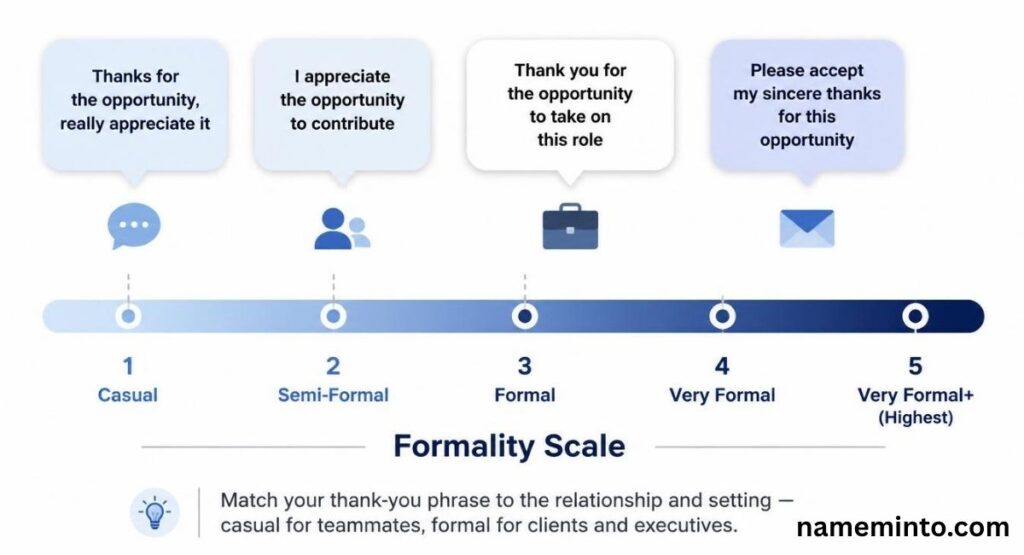
Formality Spectrum: Casual to Very Formal
| Level | Phrase Example | Best Used In |
| Very Casual | Thanks for the opportunity, really appreciate it | Team chats, Slack |
| Casual | Appreciate you giving me a shot at this | Peer-to-peer, informal teams |
| Semi-Formal | I appreciate the opportunity to contribute | Everyday professional emails |
| Formal | Thank you for the opportunity to take on this role | Job offers, interviews |
| Very Formal | Please accept my sincere thanks for this opportunity | Executive letters, legal or official communication |
Use this scale as a quick check before you hit send. If the phrase feels one level too formal or too casual for the relationship, adjust it before sending.
FAQs
Is “thank you for the opportunity” overused?
Yes, it’s one of the most common professional phrases. It still works, but varying it makes your message feel more personal and memorable.
What’s a professional way to say thank you for the opportunity?
“I appreciate the opportunity” or “I’m grateful for the opportunity to contribute” both work well in formal settings.
How do you say thank you for the opportunity in an email?
Name what you’re thankful for specifically, like “Thank you for the opportunity to interview with your team,” rather than using the phrase alone.
What can I say instead of thank you for the opportunity in an interview?
Try “I appreciate the opportunity to interview with your team” or “Thank you for taking the time to speak with me.”
How do you thank someone for a promotion opportunity?
“Thank you for trusting me with this new role” or “I appreciate the confidence you’ve shown in my work” both fit well.
Can you use “thank you for the opportunity” after a rejection?
Yes. A short line like “Thank you for considering me for this role” keeps the relationship positive for future opportunities.
Conclusion
“Thank you for the opportunity” will always be a safe choice, but it doesn’t have to be your only choice. Whether you’re following up after an interview, accepting a promotion, or thanking a mentor, the right phrase makes your gratitude feel specific and real instead of routine.
Use the categories above to match your tone to the moment, borrow a template when you need to move fast, and keep the formality scale handy for a quick gut check before you hit send.
Read Next : 30+ Formal Ways to Say ‘Thanks for Checking In’ (With Email Templates & Examples) [2026]

Grant Ellison is an English language writer and editor with a passion for making grammar, word meanings, and everyday expressions easy to understand. He researches trusted language references and creates clear, accurate content that helps readers improve their English with confidence.
